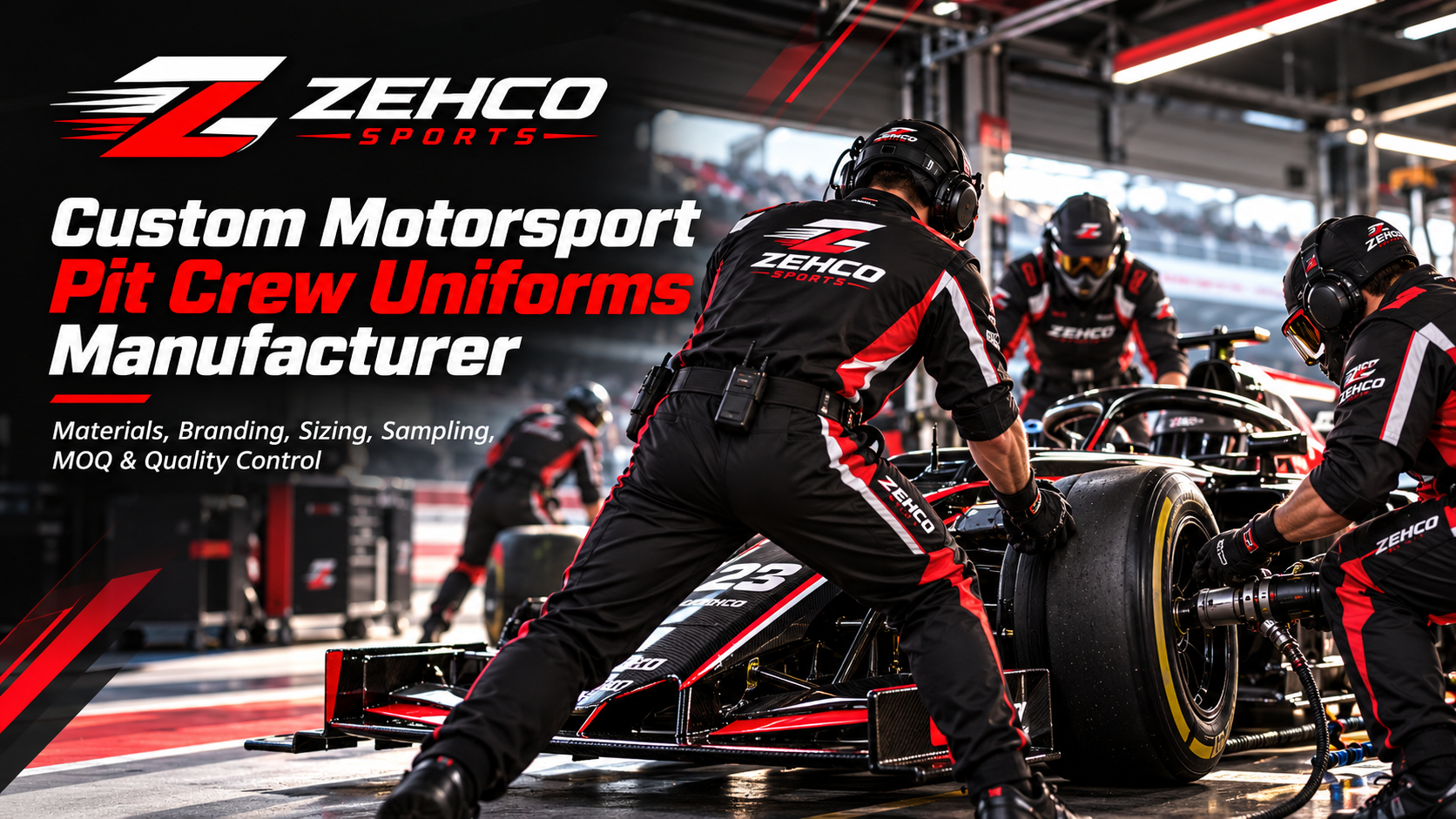
Custom Motorsport Pit Crew Uniforms: A Complete OEM Manufacturing Guide for Racing Teams
Professional motorsport teams depend on more than racing vehicles, experienced drivers and technical equipment. Behind every successful racing operation is a coordinated team of mechanics, engineers, technicians and support personnel. Their uniforms help establish a recognizable team identity while supporting comfort, organization and performance during demanding working conditions.
For racing teams, automotive companies, apparel brands and international distributors, sourcing custom motorsport pit crew uniforms requires careful consideration of fabric performance, garment construction, sizing, branding, sampling and quality control. Uniforms must be designed around the actual duties of the personnel wearing them rather than their visual appearance alone.
ZEHCO Sports, a custom sportswear and racing-gear manufacturer based in Sialkot, Pakistan, provides OEM, ODM and private-label manufacturing solutions for international buyers seeking customized motorsport apparel. This guide explains the important specifications and production decisions involved in developing professional racing team uniforms.
1. What Are Custom Motorsport Pit Crew Uniforms?
Motorsport pit crew uniforms are specialized team garments designed for personnel working in racing garages, paddocks, workshops and competition environments. Depending on the motorsport category and individual job responsibilities, uniforms may include technical polo shirts, mechanic shirts, work trousers, lightweight jackets, coveralls and coordinated team apparel.
Different team members can require different clothing specifications. Engineers working with monitoring equipment may prioritize breathable fabrics and comfortable movement, while mechanics handling equipment may need reinforced construction and practical storage features.
Typical custom uniform collections include:
- Pit crew polo shirts: Lightweight, breathable garments suitable for team personnel and technical staff.
- Mechanic work shirts: Durable garments designed for repeated movement and workshop activities.
- Technical work trousers: Functional trousers featuring reinforced construction and practical pocket arrangements.
- Motorsport team jackets: Customized outerwear for paddock, travel and cooler working environments.
- Mechanic coveralls: Full-body garments designed according to the team's working environment and applicable safety specifications.
- Team presentation apparel: Coordinated garments for managers, support staff and promotional appearances.
Buyers should distinguish ordinary branded team apparel from protective motorsport clothing. A visually similar uniform does not necessarily provide the same level of protection against flame, heat or other workplace hazards.
2. Selecting the Right Materials for Motorsport Team Uniforms
Fabric selection directly influences garment comfort, durability, breathability, appearance and overall manufacturing cost. The correct material depends on the intended working environment, frequency of use and required protective properties.
Polyester Performance Fabrics
Polyester fabrics are commonly selected for technical team shirts because they can provide good dimensional stability, color retention and moisture-management performance when appropriately engineered.
Polyester also supports sublimation printing, allowing detailed artwork and multiple colors to be incorporated into suitable light-colored garments.
Polyester and Cotton Blends
Polyester-cotton blends can be useful for mechanic shirts, casual paddock uniforms and selected workwear applications. Buyers may select these fabrics when seeking a balance of comfort, appearance, care requirements and durability.
Fabric weight, weave, finishing and construction should be evaluated together rather than assuming every polyester-cotton blend performs identically.
Stretch Performance Materials
Stretch fabrics incorporating elastane can improve movement in selected garment areas, particularly when mechanics frequently bend, reach or work in restricted positions.
However, stretch materials must be assessed for their suitability in the intended environment. Ordinary elastane-blend performance fabrics should not be treated as suitable for flame-exposure applications without appropriate testing and approval.
Flame-Resistant Protective Materials
Some motorsport activities require specialist protective clothing. For example, FIA Standard 8867-2016 addresses protective clothing for mechanics, while FIA Standard 8856-2018 concerns protective clothing for automobile drivers.
Important: Standard polyester uniforms, ordinary cotton-blend workwear and decorative racing coveralls must not be represented as FIA-approved or flame-resistant protective equipment without the relevant verified certification, testing and homologation where applicable.
Teams should confirm the regulations of their championship, event organizer and working environment before ordering protective garments. Where certified clothing is required, buyers should request documentation identifying the approved product, applicable standard and scope of approval.
3. Ergonomic Design and Functional Uniform Construction
Motorsport environments often involve repetitive movement, prolonged standing, equipment handling and rapid changes between different tasks. Uniform design should accommodate these practical requirements.
Useful design features may include:
- Articulated or movement-friendly sleeve construction.
- Comfortable shoulder and underarm pattern engineering.
- Reinforced seams at frequently stressed locations.
- Secure pockets for approved tools and small accessories.
- Adjustable waist arrangements where appropriate.
- Durable closures selected for the intended working conditions.
- Ventilation features in non-protective garments where suitable.
- Consistent panel placement for coordinated team branding.
Buyers should avoid adding unnecessary decorative details that could interfere with moving equipment or create snagging hazards. Pocket placement, external accessories and loose garment components should be reviewed against the team's workplace safety requirements.
For protective clothing, construction details and modifications must follow the applicable approved specification rather than ordinary fashion design preferences.
4. Custom Branding: Embroidery, Sublimation and Heat Transfers
Custom branding is an important part of motorsport apparel development. Racing teams frequently require multiple sponsor identities, technical partner marks and consistent team colors across several garment types.
Sublimation Printing
Sublimation is suitable for compatible polyester garments and can reproduce multicolor artwork, gradients and detailed graphic layouts.
It is especially useful for technical polo shirts, promotional team jerseys and other non-protective performance apparel. The printing process should be considered during material selection because sublimation generally works best on suitable light-colored polyester fabrics.
Embroidery
Embroidery creates a textured appearance and can be selected for team emblems, staff uniforms and premium presentation clothing.
Embroidery placement should account for garment thickness, wearer comfort and the potential effect of stitching on the underlying material. Dense embroidery may not be appropriate for every fabric or protective garment.
Heat Transfer Branding
Heat transfer applications can reproduce detailed designs on suitable materials. Buyers should confirm wash resistance, adhesion, flexibility and compatibility with the selected garment.
Heat transfers and other decorations must not be applied to certified protective clothing unless the applicable approval and manufacturer instructions specifically permit them.
Private Label Customization
For apparel brands and distributors, private-label manufacturing can include custom neck labels, woven labels, care labels, packaging, hangtags and brand-specific garment designs.
For international buyers, clear approval of trademark artwork, logo ownership and packaging specifications helps prevent production disputes and ensures consistent brand presentation.
5. Sizing and Fit Development for International Motorsport Teams
One of the most important aspects of custom uniform manufacturing is developing a reliable size chart. Motorsport teams may include personnel with different body measurements, fit preferences and work responsibilities.
Rather than relying exclusively on generic small, medium and large labels, buyers should establish garment measurements and corresponding fit tolerances.
Essential Garment Measurements
- Chest circumference and garment chest width.
- Shoulder width and sleeve length.
- Body length and hem circumference.
- Waist and hip measurements.
- Inseam and outseam measurements for trousers.
- Thigh and knee allowances where needed.
- Required movement ease for working positions.
Manufacturers should distinguish between body measurements and finished garment measurements. For example, the finished chest measurement normally includes wearing ease beyond the body measurement, depending on the intended fit.
Buyers may request regular-fit, athletic-fit or relaxed-fit specifications, although these descriptions should always be supported by actual measurements.
Before bulk production, fit samples should be tested while standing, bending, reaching and performing realistic work movements. This helps identify restricted areas, unsuitable lengths and excessive fabric before the final patterns are approved.
6. OEM Sampling and Prototype Development
Sampling allows racing teams and apparel brands to evaluate a design before committing to production quantities.
At ZEHCO Sports, custom manufacturing projects can be discussed around the buyer's technical requirements, artwork, fabric preferences and desired garment construction.
Recommended Sampling Workflow
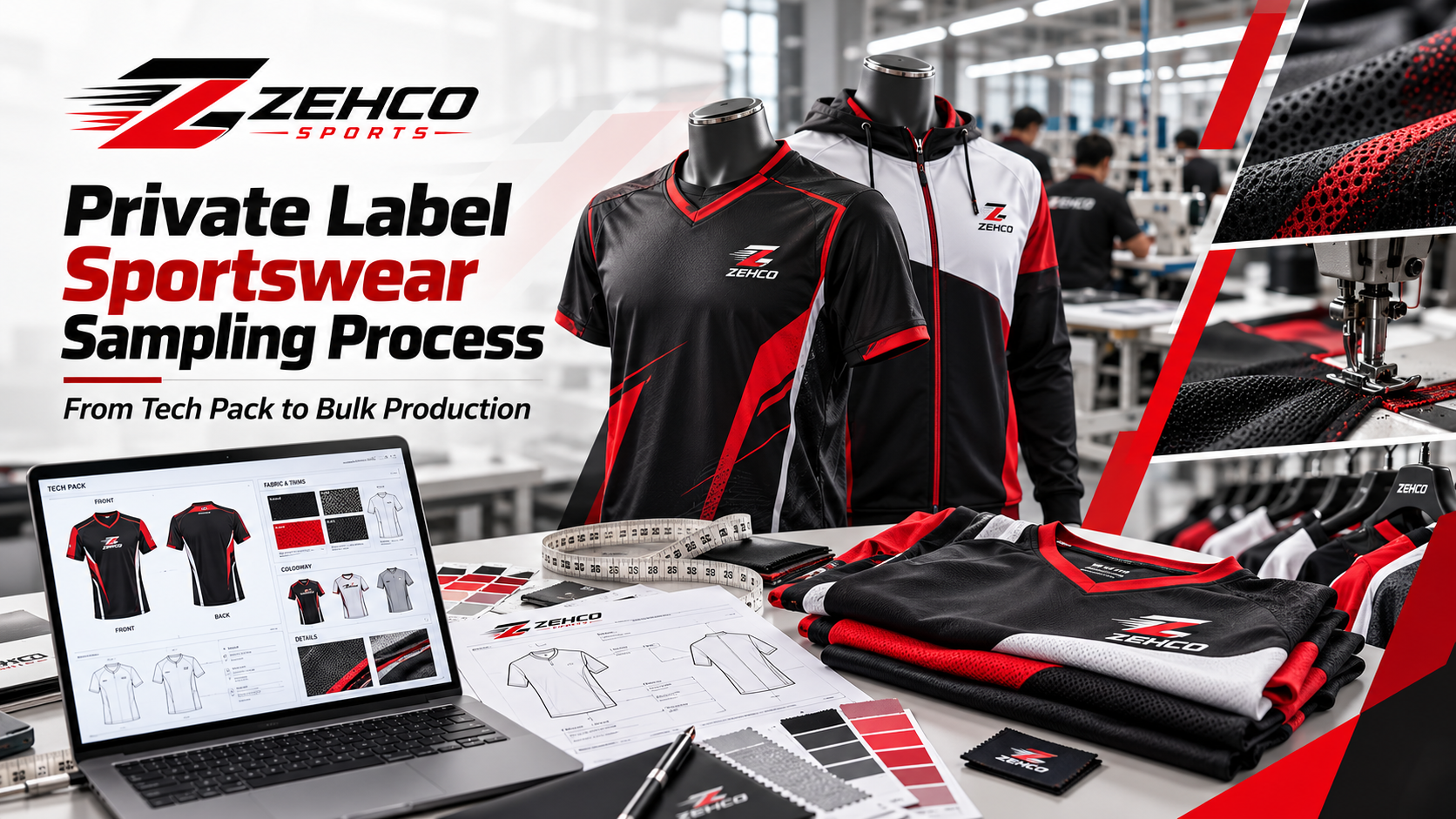
- Step 1 — Technical specification: Provide garment sketches, reference samples or a detailed tech pack.
- Step 2 — Material selection: Identify required fabric composition, approximate weight, construction and finishing.
- Step 3 — Artwork approval: Confirm sponsor logos, colors, placement dimensions and printing or embroidery methods.
- Step 4 — Pattern development: Prepare the initial garment pattern using the agreed measurement chart.
- Step 5 — Prototype manufacturing: Produce a sample incorporating the approved design requirements.
- Step 6 — Sample evaluation: Inspect dimensions, fit, workmanship, branding and material characteristics.
- Step 7 — Revision: Document requested adjustments before preparing the production-approved sample.
- Step 8 — Bulk approval: Confirm the final specifications, quantities, packaging and inspection requirements.
Sampling charges, revision costs and delivery arrangements depend on the complexity of the design and the selected materials. Buyers should request written confirmation of these commercial terms before sample production.
7. Minimum Order Quantity (MOQ) and Bulk Manufacturing
Minimum order quantity is an important consideration for racing teams, emerging apparel brands and distributors purchasing custom uniforms.
The MOQ for a custom manufacturing project depends on several factors, including:
- Fabric availability and minimum procurement quantities.
- Number of garment styles and color combinations.
- Customization complexity and artwork requirements.
- Printing, embroidery and other finishing processes.
- Number of sizes required within the order.
- Special trims, labels and packaging materials.
- Whether the design requires protective or certified components.
For example, a straightforward sublimated team shirt may involve different production considerations from a complex mechanic coverall using multiple fabrics, reinforced sections and specialized closures.
Buyers should ask whether the quoted MOQ applies per design, per color, per style or across the complete order. They should also verify whether mixed-size orders are permitted.
ZEHCO Sports works with buyers to discuss project-specific OEM and private-label production requirements. Exact minimum quantities, unit prices and production schedules should be confirmed through an individual quotation rather than assumed to be identical for every garment.
8. Quality Control for Custom Pit Crew Uniform Manufacturing
Reliable quality control helps ensure that garments remain consistent throughout a production batch. For racing organizations, inconsistent sizing, misplaced sponsor graphics and poor seam construction can undermine the professional appearance of an entire team.
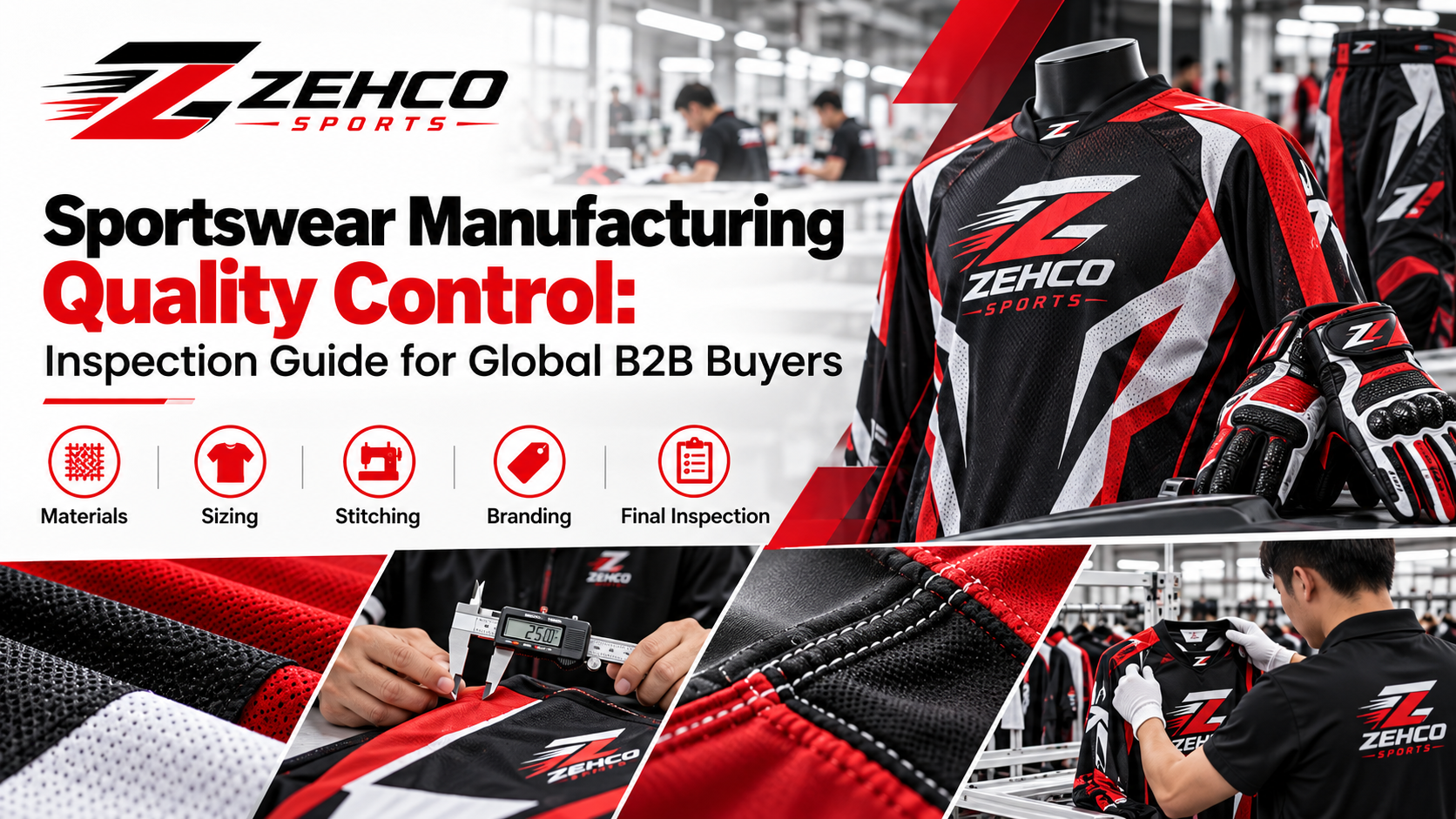
Incoming Fabric Inspection
Fabric should be checked against the approved specifications for composition, weight, color, appearance and relevant performance requirements. Where applicable, buyers may specify independently verified test methods.
Cutting and Pattern Accuracy
Cutting checks help identify incorrect pattern dimensions, panel orientation and inconsistent size grading before assembly.
Stitching and Seam Inspection
Production inspectors should review stitch consistency, seam integrity, loose threads, reinforcement details and overall workmanship.
Branding and Color Consistency
Printed and embroidered designs should be compared with approved artwork. Sponsor placement, dimensions and color expectations should be documented before mass production.
Finished Garment Measurements
Inspection teams should measure selected finished garments against the approved size specifications and agreed tolerances.
Final Inspection and Packaging
Final checks should cover garment appearance, labeling, size identification, packaging accuracy and quantities. Buyers may also agree on an appropriate sampling inspection plan and acceptance criteria before shipment.
For protective motorsport clothing, ordinary garment inspection is not a substitute for the required conformity assessment, certification or homologation.
9. How to Calculate the Cost of Custom Motorsport Uniforms
Understanding the components of manufacturing cost helps international buyers compare quotations accurately.
The overall unit price is influenced by fabric selection, pattern complexity, material consumption, branding techniques, production quantity and packaging requirements.
Important commercial cost components include:
- Base fabric and supporting materials.
- Pattern development and cutting.
- Sewing and garment assembly.
- Embroidery, sublimation or approved decoration.
- Trims, closures, labels and accessories.
- Inspection and quality assurance.
- Individual packaging and carton preparation.
- Applicable development, testing and certification costs.
- Freight, insurance and import charges according to the agreed Incoterms.
Buyers should compare like-for-like specifications rather than relying only on the lowest quoted unit price. Two garments with similar appearances may have substantially different material compositions, seam construction, durability and compliance requirements.
Written quotations should clearly indicate what is included and excluded, especially sampling, tooling, testing, shipping and customs-related costs.
10. OEM and Private Label Motorsport Apparel Manufacturing in Sialkot, Pakistan
Sialkot, Pakistan, is an established manufacturing center for sporting goods, technical apparel and customized sportswear. Its supplier ecosystem offers access to garment production capabilities that can support internationally oriented apparel development.
ZEHCO Sports operates in this manufacturing environment, focusing on customized sportswear, racing gear and private-label garment production for business buyers.
For motorsport apparel sourcing, effective collaboration depends on the exchange of accurate technical specifications, approved artwork, realistic sample expectations and clearly documented production requirements.
International buyers should evaluate a manufacturer's ability to communicate technical details, manage revisions, maintain consistent construction and provide appropriate evidence for any claimed product certifications.
11. Important Safety and Compliance Considerations
Motorsport apparel is not a single safety category. The clothing requirements for garage staff, promotional teams, refueling personnel, mechanics and drivers may differ substantially.
The applicable competition regulations, workplace hazard assessment and garment purpose should guide the product specification.
Buyers sourcing uniforms for potentially hazardous pit operations should consider the following:
- Confirm whether the intended activity requires flame-resistant protective clothing.
- Identify any applicable FIA, championship or workplace safety requirements.
- Request valid approval or certification documents where mandatory.
- Verify that the actual supplied garment matches the documented approved model.
- Confirm whether logos, patches and decorative treatments are permitted.
- Avoid substituting standard promotional sportswear for required protective equipment.
The FIA publishes relevant motorsport clothing standards and homologation information at https://www.fia.com/regulation/category/98. Buyers should consult the applicable current regulations and qualified safety personnel before purchasing protective apparel.
Safety compliance must be established through appropriate documentation and assessment, not inferred from fabric appearance, marketing terminology or a manufacturer's general experience.
12. Why Choose ZEHCO Sports for Custom Motorsport Team Apparel?
When developing a professional racing team apparel collection, buyers benefit from working with a manufacturer that understands the relationship between functional garment construction, coordinated design and repeatable production specifications.
ZEHCO Sports provides a manufacturing point of contact in Sialkot, Pakistan, for international brands, teams and distributors exploring customized sportswear and motorsport apparel.
Custom development discussions can include fabric options, garment construction, embroidered or printed branding, size requirements, private-label presentation, sampling and production quotations.
For buyers establishing a new motorsport apparel collection, a comprehensive tech pack and approved reference sample can improve communication and reduce costly production revisions.
13. Frequently Asked Questions About Custom Pit Crew Uniforms
Can pit crew uniforms be manufactured with custom team logos?
Yes. Ordinary non-protective team apparel can be customized using compatible embroidery, sublimation and transfer techniques. For protective garments, decoration must comply with the applicable product approval and safety requirements.
What materials are suitable for racing mechanic uniforms?
Material selection depends on the mechanic's tasks and working conditions. Polyester blends, cotton blends and technical performance fabrics may suit selected non-protective applications, while hazardous operations may require appropriately certified protective clothing.
Can buyers order several sizes within one production batch?
Mixed-size production can be discussed during quotation preparation. Buyers should submit a complete size breakdown and confirm any size-related minimum quantities.
What is the MOQ for private-label motorsport uniforms?
The minimum order quantity depends on the garment style, fabric sourcing, branding requirements and manufacturing complexity. ZEHCO Sports can review project specifications and provide an individual quotation.
Can international buyers request samples before bulk production?
Yes. Sampling requirements can be discussed before placing a bulk order. Sample pricing, revisions and delivery arrangements should be agreed in writing.
Are all motorsport uniforms flame resistant?
No. Standard branded team uniforms are not automatically flame resistant or suitable for hazardous pit operations. Protective performance must be supported by the appropriate approved materials, testing and certification.
14. Request a Custom Motorsport Pit Crew Uniform Manufacturing Quotation
Developing professional motorsport uniforms requires more than selecting team colors and adding sponsor logos. Successful OEM production combines suitable materials, functional pattern construction, accurate sizing, durable decoration, reliable sampling and systematic quality control.
Whether you represent a motorsport team, automotive apparel brand, racing club or international distributor, clearly defined product requirements are essential for achieving consistent results.
ZEHCO Sports welcomes inquiries from B2B buyers seeking customized motorsport apparel and private-label manufacturing solutions in Sialkot, Pakistan.
For an accurate quotation, provide your garment type, reference images or tech pack, required materials, branding artwork, estimated order quantity, size breakdown, destination country and desired delivery schedule.
Contact ZEHCO Sports: https://zehcosports.com/
ZEHCO Sports — Custom Sportswear, Racing Gear and OEM Apparel Manufacturing in Sialkot, Pakistan.