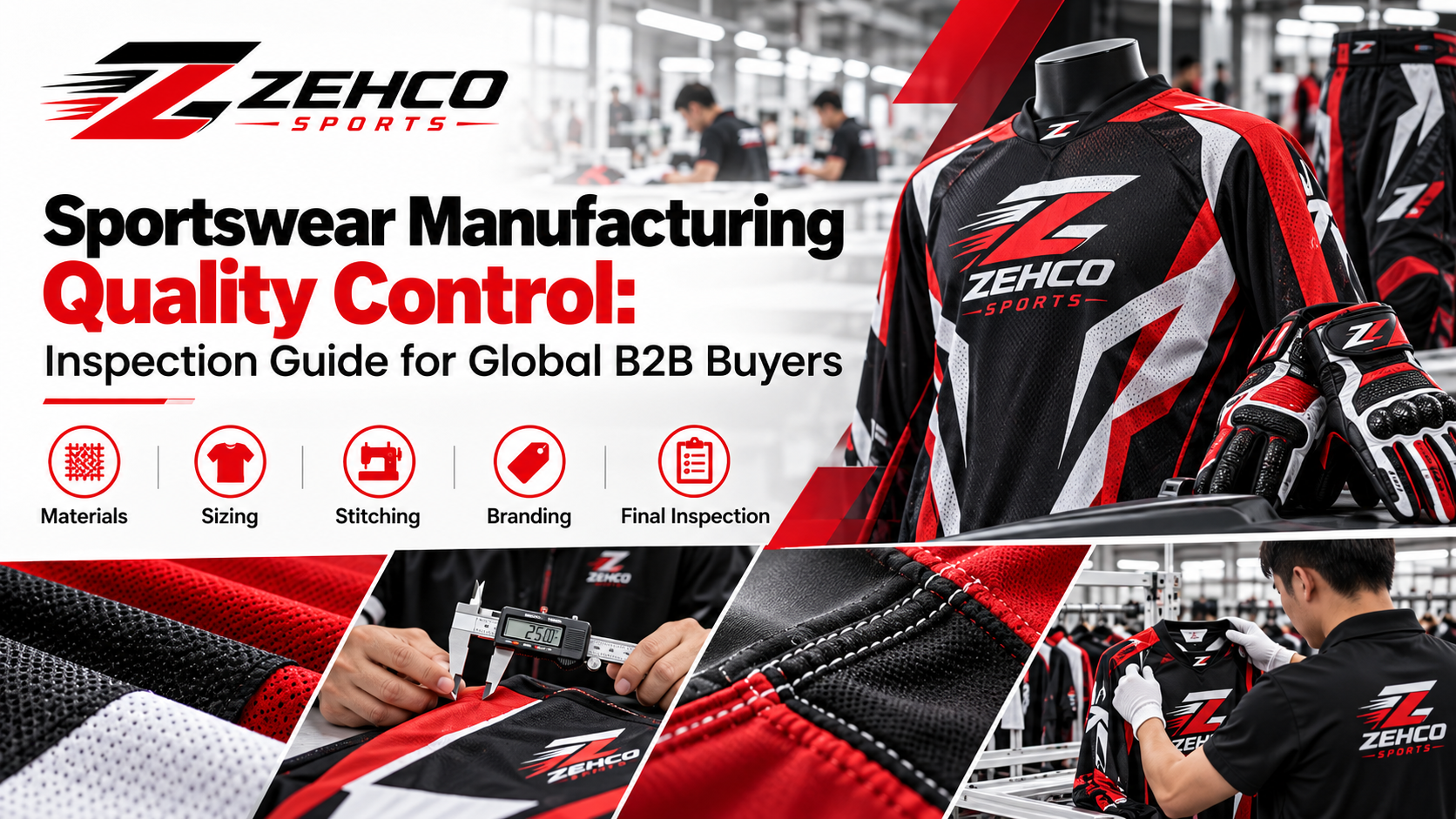
For apparel brands, distributors, sports clubs and international importers, sportswear manufacturing quality control is one of the most important factors separating a successful production order from costly returns, inconsistent sizing and damaged brand reputation. Buyers sourcing custom teamwear, racing apparel, fight wear or other performance garments need more than an attractive sample. They need a manufacturing system capable of reproducing approved specifications consistently across dozens, hundreds or thousands of units.
ZEHCO Sports is a custom OEM, ODM and private-label sportswear and racing gear manufacturer based in Sialkot, Pakistan. For international buyers, understanding how quality should be controlled from raw material selection through final packing makes it easier to communicate specifications, evaluate samples and manage repeat bulk production.
Why Sportswear Manufacturing Quality Control Matters
Sportswear is technically more demanding than many ordinary fashion garments. A product may need to stretch during movement, resist repeated washing, manage moisture, retain printed graphics and maintain accurate sizing across multiple production batches. Motorcycle and motorsport products can introduce additional requirements involving abrasion-resistant materials, reinforcement panels, protectors, heavy-duty stitching and specialized closures.
A small manufacturing inconsistency can therefore create a significant commercial problem. A jersey that is two centimeters wider than the approved size chart may lead to customer complaints. Incorrect logo placement can make an entire team order unusable. Weak seams in high-stress areas can result in premature product failure, while inconsistent fabric shades can make garments within the same shipment appear to come from different production runs.
Effective quality control reduces these risks by establishing measurable standards before mass production begins and checking those standards throughout the manufacturing process.
Start Quality Control Before Production Begins
Prepare a Detailed Technical Specification
Quality cannot be inspected accurately when the buyer and manufacturer have not agreed on what the finished product should be. International buyers should provide a technical specification or tech pack containing as much relevant information as possible.
- Garment measurements and size grading
- Fabric composition and preferred weight
- Color references or Pantone codes where applicable
- Logo dimensions and placement
- Printing, embroidery or patch specifications
- Stitching requirements
- Label and care label details
- Zipper, button, hook-and-loop or other accessory requirements
- Packaging and carton specifications
If the buyer does not have a complete tech pack, an experienced OEM manufacturer can often develop specifications from reference garments, sketches, artwork or product descriptions. However, the final specification should still be documented and approved before bulk production.
Define Tolerances
Garment dimensions cannot realistically remain identical down to fractions of a millimeter. Professional production therefore uses measurement tolerances. Buyers should define acceptable tolerances for important points of measurement such as chest width, body length, sleeve length, waist, inseam and other product-specific dimensions.
Agreeing on tolerances before production prevents disagreements during inspection. Instead of deciding subjectively whether a garment is acceptable, both parties can compare the finished product against an approved measurement standard.
Raw Material Inspection for Custom Sportswear
Quality control should begin before fabric reaches the cutting table. Materials that fail at the beginning of production cannot usually be corrected later without replacing them.
Fabric Composition and Construction
The manufacturer should verify that the selected fabric matches the approved specification. Depending on the garment, buyers may request polyester, polyester-spandex blends, mesh, fleece, microfiber, leather, Cordura-type materials or other performance textiles.
Important characteristics can include fabric weight, stretch direction, surface finish, breathability, moisture management and durability. Buyers should avoid selecting fabric based only on appearance because two visually similar materials can perform very differently after repeated use and washing.
Color Consistency
Color variation is particularly important for team uniforms and branded collections. Fabric rolls should be checked for visible shade differences before cutting. Where multiple materials are used in the same garment, buyers should also consider how closely those materials need to match.
For repeat orders, buyers should understand that dye lots may vary slightly between production runs. Maintaining documented color references and approved material samples can help the manufacturer match future production as closely as practical.
Trims and Accessories
Zippers, drawcords, elastic, snaps, hook-and-loop closures, labels and other components should be reviewed before assembly. A premium fabric combined with an unreliable zipper still produces an unsatisfactory garment.
Accessory specifications are especially important for motorcycle jackets, racing suits, tracksuits and technical sportswear where closures receive frequent mechanical stress.
Pattern, Cutting and Size Accuracy
Accurate patterns are the foundation of consistent sizing. Before bulk cutting begins, patterns should be developed according to the approved sample and size chart. Size grading then determines how dimensions increase or decrease across the full size range.
Buyers should pay particular attention to products with complex panel construction. Racing apparel, compression garments, fight wear and performance uniforms may contain multiple shaped panels that affect both fit and mobility.
During cutting, fabric layers must remain properly aligned. Incorrect cutting can produce mismatched panels, distorted graphics or inconsistent garment dimensions. Manufacturers should also consider fabric direction where stretch, surface texture or printed patterns make orientation important.
Stitching and Seam Inspection
Stitching is one of the most visible indicators of manufacturing consistency. It also has a direct effect on garment durability.
Quality inspectors should examine seam construction for skipped stitches, broken threads, loose thread ends, puckering, uneven stitch lines and incomplete seams. High-stress zones may require reinforcement depending on the product design.
For sportswear that experiences frequent stretching, seam construction should allow appropriate movement without breaking. Different garments may require overlock, flatlock, lockstitch, coverstitch or combinations of several stitching methods.
Buyers should not automatically assume that more stitching is always better. The appropriate seam depends on the material, product function, appearance requirement and stress level of the construction area.
Printing, Sublimation and Embroidery Quality Control
Branding is critical in private-label sportswear manufacturing because even a well-constructed garment can be rejected if the logo is incorrect.
Sublimation Printing
Sublimation is widely used for polyester teamwear because detailed graphics can become part of the fabric rather than sitting as a heavy surface layer. Quality control should check color accuracy, image clarity, panel alignment and whether graphics remain properly positioned after the garment is assembled.
Screen Printing and Heat Transfers
Printed areas should be checked for correct positioning, clean edges, proper adhesion and consistent coverage. The suitable printing technique depends on fabric composition, artwork, quantity and intended garment use.
Embroidery
Embroidery inspection should include thread color, logo dimensions, stitch density, backing, alignment and surrounding fabric distortion. Large or very dense embroidery designs can affect lightweight performance materials, so branding methods should be selected according to the garment rather than simply copied from another product category.
Sample Approval Before Bulk Manufacturing
Sampling is one of the most effective quality-control stages available to an international buyer. A sample allows the buyer to examine materials, fit, construction and branding before committing to full production.
Buyers should treat sample approval as a technical process rather than simply confirming that the product looks acceptable in photographs. Measure the sample against the size chart, inspect stitching, test closures, check branding dimensions and evaluate how the garment performs when worn.
If changes are required, they should be clearly documented. Statements such as “make it slightly bigger” can create uncertainty. It is better to request a specific dimensional change, identify the relevant measurement point and confirm whether the adjustment applies to one size or the entire graded size range.
Pre-Production Sample and Golden Sample Control
Once the final design is approved, buyers and manufacturers can establish an approved reference sample commonly treated as the production standard. This reference helps factory teams compare bulk units with the buyer-approved product.
The approved sample should reflect the intended fabric, colors, branding, trims and construction as closely as possible. When substitutions are necessary because of supply availability, they should be discussed before production instead of being introduced without buyer approval.
In-Line Inspection During Bulk Production
Waiting until the entire order is finished before inspecting quality can be expensive. If a repeated manufacturing defect is discovered after thousands of units are completed, rework becomes difficult and may delay shipment.
In-line inspection allows manufacturers to identify problems while production is still underway. Typical checks include:
- Correct material being used for each product panel
- Accurate sewing construction
- Measurement consistency
- Logo placement
- Color matching
- Attachment of labels and trims
- Clean workmanship
Early detection allows operators to correct processes before the same defect spreads through the entire order.
Final Sportswear Quality Inspection
Final inspection should take place after garments are completed but before shipment. The objective is to confirm that finished goods correspond with the approved specifications and are commercially suitable for delivery.
Measurement Checks
Selected garments from different sizes should be measured against the approved size chart and tolerance limits. A proper inspection should examine more than one measurement point because a garment may have the correct chest dimension while the sleeve or total length is incorrect.
Visual Workmanship Inspection
Inspectors should look for stains, fabric damage, loose threads, incorrect stitching, printing defects, damaged accessories and other visible problems. Garments should also be checked for symmetry where relevant.
Branding Verification
Private-label orders should be verified against approved artwork. Inspectors should confirm logos, spelling, colors, neck labels, size labels, care labels and packaging branding.
This step is especially important when a factory produces merchandise for multiple brands, because incorrect labels or packaging can create serious commercial and confidentiality problems.
Packaging Quality Control for International Shipments
Quality control does not end when manufacturing is complete. International shipments may pass through warehouses, ports, freight terminals and customs facilities before reaching the buyer.
Individual polybags, size stickers, hangtags, inner cartons and export cartons should follow the agreed packing specification. Cartons should be strong enough for the shipment method and clearly marked when the buyer requires specific carton identification.
Buyers should communicate assortment requirements in advance. For example, a distributor may require one size per carton while a sports club may prefer complete team sets packed together. Planning this before packing reduces repacking work at the destination.
Managing Quality Across Repeat Bulk Orders
Repeat orders are where a supplier relationship becomes particularly valuable. Buyers generally want their second, third and future orders to match the original approved product.
Maintaining technical files, size charts, artwork, material references and approved samples helps improve repeatability. Buyers should also identify any changes when placing repeat orders rather than assuming previous specifications automatically apply.
Long-term sourcing relationships can become more efficient because the manufacturer develops familiarity with the brand's fit preferences, packaging methods, labeling system and quality expectations. However, each production run should still be controlled because materials, operators and production conditions can change.
Questions B2B Buyers Should Ask a Sportswear Manufacturer
Before placing an OEM or private-label order, international buyers can reduce sourcing risk by asking practical questions about the manufacturer's workflow.
- Can you manufacture from our tech pack or reference sample?
- What materials are available for our specific product?
- Can you develop a sample before bulk production?
- How are measurements checked during production?
- What printing and embroidery methods are available?
- How are logos and private labels controlled?
- Can custom packaging be supplied?
- What is the minimum order quantity for our design?
- What production lead time should we expect after sample approval?
- How do you manage repeat production using previously approved specifications?
The objective is not simply to obtain yes-or-no answers. Buyers should determine whether the manufacturer has a structured process for converting specifications into repeatable production.
How ZEHCO Sports Supports Custom Manufacturing Projects
ZEHCO Sports works with international apparel brands, distributors, racing teams, sports clubs, sourcing professionals and importers requiring custom OEM, ODM and private-label production from Sialkot, Pakistan.
Manufacturing projects can involve motorcycle racing wear, racing gloves, motorcycle jackets, motorsport suits, team sportswear and fight wear. Depending on the product, buyers can discuss materials, construction, sizes, custom colors, logos, labels, packaging and other private-label requirements before production begins.
For new products, sampling provides an important opportunity to confirm the design before moving toward bulk production. Buyers planning repeat orders should also communicate projected quantities and future requirements so manufacturing specifications can be organized with long-term consistency in mind.
Conclusion: Build Quality Into the Manufacturing Process
Reliable sportswear manufacturing quality control is not a single inspection performed immediately before shipping. It begins with clear specifications and continues through material selection, sampling, cutting, stitching, branding, in-line checks, final inspection and export packaging.
International buyers can reduce production risk by documenting requirements, approving samples carefully, defining measurement tolerances and communicating branding and packing details before bulk manufacturing starts. For brands, distributors and teams seeking OEM or private-label production, a disciplined quality-control process helps protect product consistency, customer satisfaction and the long-term value of the brand.
ZEHCO Sports supports international buyers seeking custom sportswear and racing gear manufacturing in Sialkot, Pakistan. Buyers can contact the ZEHCO Sports team with product specifications, artwork, target quantities, sizing requirements and reference designs to discuss sampling and bulk production options.