```html
Developing an accurate custom sportswear size chart is one of the most important steps in sourcing team uniforms, training apparel and private-label athletic clothing. For international B2B buyers, incorrect measurements can lead to inconsistent fit, expensive alterations, customer returns and delayed deliveries. Apparel brands, sports clubs and distributors must establish clear measurement specifications before moving from product development to bulk manufacturing. This guide explains how to build size charts, evaluate grading rules, approve fit samples and maintain consistent sizing throughout OEM sportswear production.
Why a Custom Sportswear Size Chart Matters in OEM Manufacturing
Sportswear sizing involves more than assigning familiar labels such as Small, Medium or Large. Two manufacturers may produce garments carrying the same size label but with significantly different chest widths, lengths or sleeve measurements. This can create serious problems for brands selling across multiple markets.
A properly documented size chart establishes measurable production requirements. It gives pattern makers a consistent reference, helps quality inspectors evaluate finished garments and allows buyers to repeat successful orders without rebuilding the sizing system.
For teamwear programs, consistency is especially important because an order may include youth and adult sizes, different garment styles and replacement uniforms purchased months later.
Body Measurements vs Finished Garment Measurements
One of the most common sourcing mistakes is confusing body measurements with finished garment dimensions. These are related but serve different purposes.
Body Measurements
Body measurements describe the wearer's physical dimensions, such as chest circumference, waist circumference, hip circumference and height. Consumer-facing size guides typically use these values to help customers choose appropriate garments.
Finished Garment Measurements
Finished garment measurements describe the actual dimensions of manufactured clothing. For example, a jersey may have a half-chest measurement taken from one underarm to the other while the garment is laid flat.
The relationship between body dimensions and garment measurements depends on the intended fit and the amount of wearing ease. A compression top may be designed with negative ease, while a relaxed training shirt normally requires additional room for movement.
Buyers should clearly identify whether every specification refers to the body or the finished garment. Mixing the two systems can create costly pattern-development errors.
Essential Measurement Points for Custom Sportswear
Measurement requirements depend on garment construction and intended sporting activity. However, most OEM teamwear programs should establish a consistent set of measurement points.
Sports Jerseys and Training Shirts
- Half-chest width: Measure across the garment below the armholes while laid flat.
- Body length: Define the reference point, such as the high shoulder point to the bottom hem.
- Shoulder width: Measure between specified shoulder seam points.
- Sleeve length: Record the distance using an agreed shoulder or neckline reference.
- Sleeve opening: Measure the flat opening at the sleeve hem.
- Bottom opening: Check the garment width at the finished lower hem.
For raglan sleeves, sleeveless jerseys and other nonstandard constructions, measurement diagrams should explain alternative reference points.
Sports Shorts and Training Trousers
- Waist width: Specify whether the elastic waistband is measured relaxed, extended or both.
- Hip width: Define the measurement location relative to the waistband.
- Inseam length: Measure from the crotch seam to the leg opening.
- Outseam length: Record the total side length using an agreed reference.
- Leg opening: Check the finished flat width.
- Rise: Specify front and back rise where relevant.
Buyers should provide measurement diagrams alongside numerical specifications because terms and measurement methods can differ between factories.
Understanding Sportswear Size Grading
Size grading is the process of systematically adjusting a base pattern to produce additional sizes. Manufacturers generally develop an approved sample size and use grading rules to create the remaining size range.
For example, a hypothetical training jersey with a 54 cm half-chest measurement in size Medium might use a 2 cm half-chest increase between adjacent adult sizes. However, this is only an illustration, not a universal standard. Actual grade increments depend on fit, customer demographics, fabric stretch and the brand's sizing strategy.
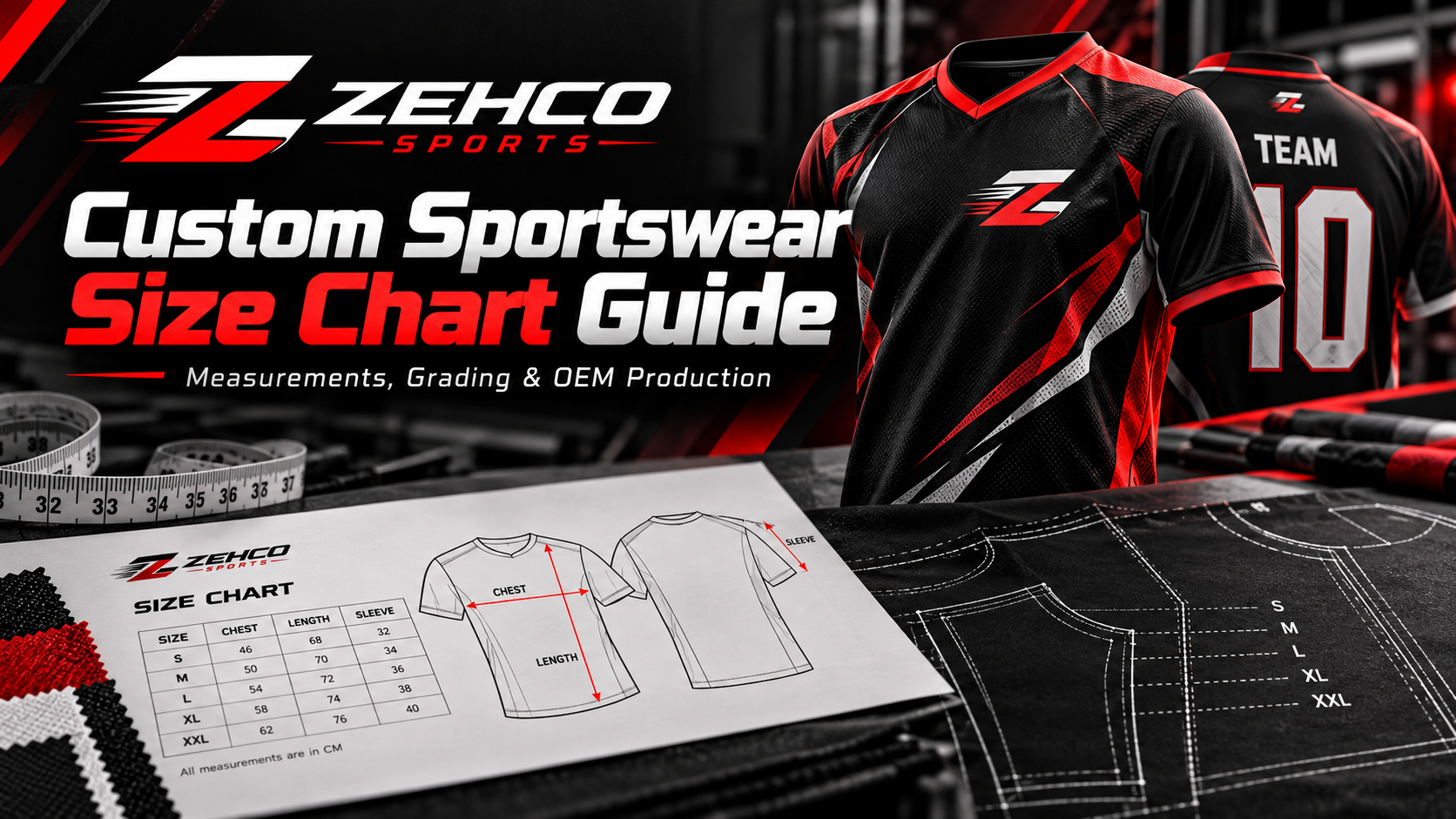
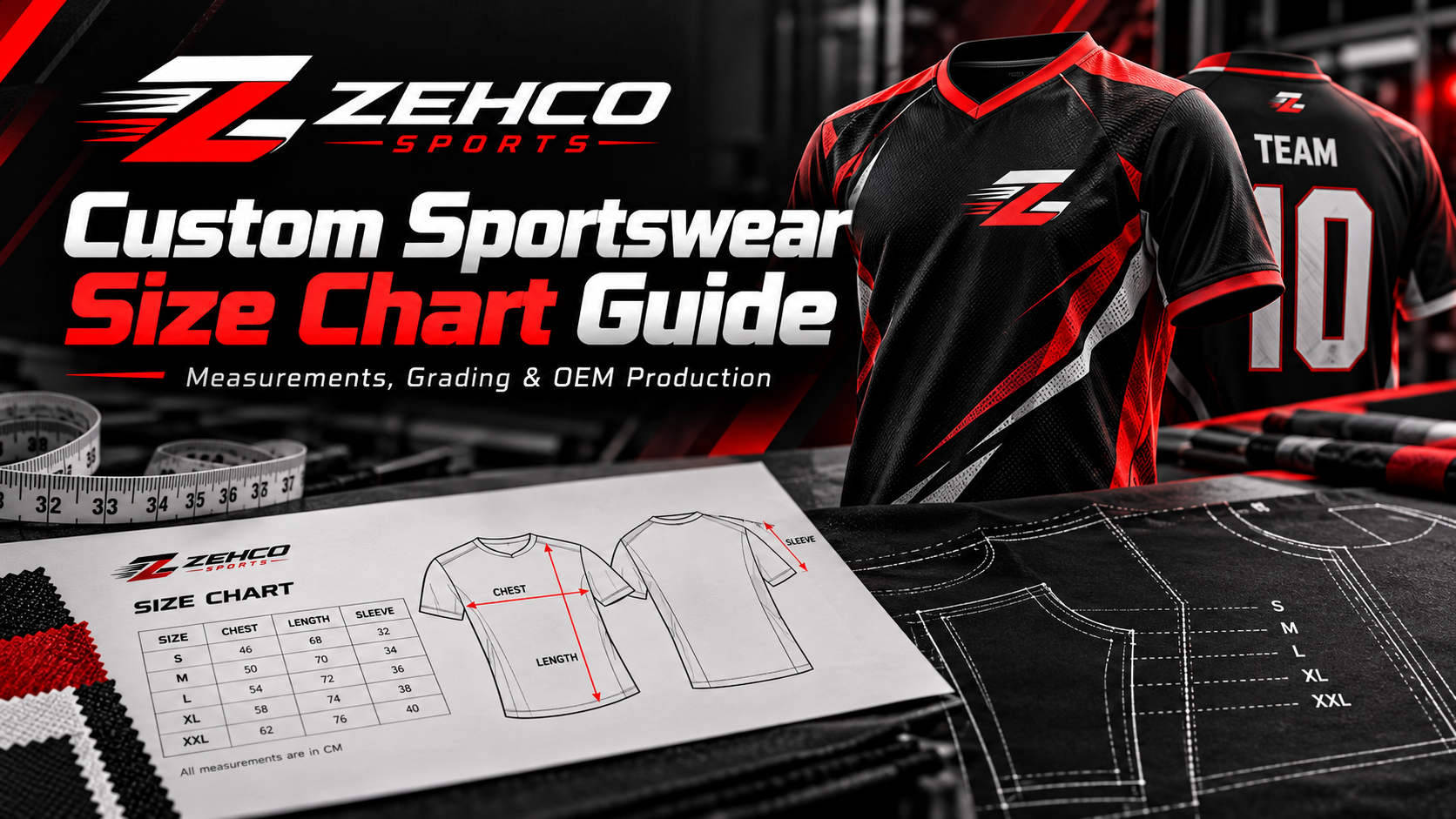
Illustrative Adult Jersey Measurement Chart
The following figures illustrate a possible starting point for product development. They should be adjusted and validated through fittings before production.
- Small: Half chest 52 cm; body length 69 cm.
- Medium: Half chest 54 cm; body length 71 cm.
- Large: Half chest 56 cm; body length 73 cm.
- Extra Large: Half chest 58 cm; body length 75 cm.
- 2XL: Half chest 60 cm; body length 77 cm.
Not every measurement should increase at the same rate. Sleeve openings, neck dimensions, shoulders and garment lengths need their own appropriate grading rules. Youth sizes should generally be developed using age-appropriate body proportions rather than simply shrinking adult patterns.
How Fabric Selection Influences Sportswear Sizing
Fabric characteristics directly affect garment fit. Two garments cut to identical dimensions may fit differently because of differences in elasticity, weight, recovery and finishing behavior.
Polyester Performance Fabrics
Polyester is widely used in team jerseys and training apparel because it can provide durability, moisture-management properties and compatibility with sublimation printing. Buyers should examine construction and stretch properties rather than assuming that all polyester fabrics behave identically.
Polyester-Spandex Blends
Stretch blends are frequently selected for fitted training garments, compression apparel and activewear. The proportion of elastane, direction of stretch and fabric recovery influence the amount of ease required in the pattern.
Mesh and Breathable Panels
Sports garments combining solid knit fabrics with mesh panels require careful pattern planning. Different fabric constructions may stretch or shrink differently during washing and finishing, potentially affecting seams and finished dimensions.
Manufacturers and buyers should test representative production fabrics before finalizing size charts. Shrinkage testing, fit assessments and laundering evaluations can help identify problems before bulk cutting.
Fit Sample Approval Before Bulk Sportswear Production
A numerical size chart is not a substitute for physical sample approval. A garment may technically match its specified measurements yet still feel uncomfortable or restrict athletic movement.
International buyers should establish an organized sample approval process.
- Development sample: Evaluate basic construction, materials, silhouette and initial measurements.
- Fit sample: Assess garment balance, ease, mobility and size accuracy on an appropriate wearer or fit model.
- Revised sample: Confirm changes to patterns, measurements and construction details.
- Pre-production sample: Review the approved design using representative production materials, branding and finishing.
During review, buyers should check performance-specific movements. Basketball jerseys should allow comfortable overhead arm movement, while training trousers should accommodate squatting and running without excessive restriction.
Approval records should identify the sample version, date, selected fabric, measurement chart and required corrections. This reduces confusion when multiple samples and revisions are exchanged between international buyers and manufacturing teams.
Setting Acceptable Measurement Tolerances
In apparel manufacturing, small dimensional variations can occur during cutting, stitching, pressing and finishing. Buyers should therefore establish acceptable measurement tolerances rather than expecting every finished garment to match a target dimension perfectly.
For illustration, a buyer might specify a tolerance of plus or minus 1 cm for selected jersey body measurements, with tighter limits for particular openings or critical dimensions. The correct tolerance must be agreed for each measurement point and product type. This example is not a universal industry rule.
A professional specification sheet should identify the target measurement, permitted positive and negative deviations, measuring method and inspection conditions.
Quality control teams can then select finished garments from production, measure them using the approved method and record conformity against the agreed specifications.
Regional Sizing for International Sportswear Buyers
International apparel brands should avoid assuming that US, UK, European and Asian size labels correspond to identical physical measurements. Consumer expectations and brand sizing conventions vary across markets.
Rather than relying solely on regional labels, buyers should provide the actual measurements for every approved size. Conversion charts may be useful for retail presentation, but manufacturing should follow documented garment specifications.
Where a brand serves several markets, it may need separate fit blocks or specific adjustments for different customer groups. These decisions should be supported by the brand's customer measurement data, fit testing and return feedback.
Preparing an OEM Sportswear Sizing Tech Pack
Before requesting bulk production, buyers should include the approved sizing information within a complete technical package.
- Product name, style reference and intended use.
- Technical sketches showing front, back and important construction details.
- Base size and complete measurement specifications.
- Grading increments for the required size range.
- Measurement diagrams identifying exact reference points.
- Fabric composition, weight, stretch characteristics and finishing requirements.
- Approved fit category, such as slim, regular, relaxed or compression.
- Measurement tolerances and inspection requirements.
- Size label artwork, placement and packaging instructions.
- Sample approval history and final revision number.
Accurate documentation helps manufacturers prepare patterns, estimate fabric consumption and calculate production costs. It also reduces avoidable questions during manufacturing.
Managing Size Ratios and Reorders
Bulk teamwear orders rarely require equal quantities of every size. A distributor may need more Medium and Large jerseys, while a youth club may require several age-based ranges.
Buyers should submit quantities in a size-ratio breakdown, specifying product styles, colors and branding variations. The manufacturer can use this information when planning cutting, sewing, labeling and packing.
For repeat orders, maintaining approved master patterns and size charts is essential. Any change in fabric, supplier, pattern or finishing process should be assessed before assuming that the previous fit will remain unchanged.
Brands should also collect feedback about fit-related exchanges and returns. Consistent complaints about tight shoulders, short lengths or inaccurate waist dimensions may indicate that the grading system needs revision.
Working With ZEHCO Sports on Custom OEM Sizing
ZEHCO Sports is a Sialkot, Pakistan-based manufacturer serving apparel brands, clubs, distributors and sourcing buyers seeking custom sportswear and private-label production. A well-prepared sizing specification helps establish clear communication when discussing team uniforms, training apparel and related custom garments.
When submitting an inquiry, buyers should share the intended garment type, target market, preferred fit, fabric details, available reference samples, estimated order quantity and required size range. These details provide a practical basis for reviewing development requirements and discussing sampling and production arrangements.
Branding methods, packaging requirements, minimum order quantities and production schedules should also be confirmed during quotation and sample development rather than assumed in advance.
Conclusion: Build a Reliable Custom Sportswear Size Chart
A dependable custom sportswear size chart is fundamental to successful OEM sportswear sourcing. Clear measurement definitions, appropriate grading, fabric evaluation, approved fit samples and documented production tolerances help buyers reduce sizing inconsistencies and improve repeat-order reliability.
For apparel brands and international distributors planning custom teamwear manufacturing, ZEHCO Sports offers a point of contact for discussing product development, technical specifications and private-label production requirements. Visit https://zehcosports.com/ to explore the product portfolio and submit your sourcing inquiry.
```