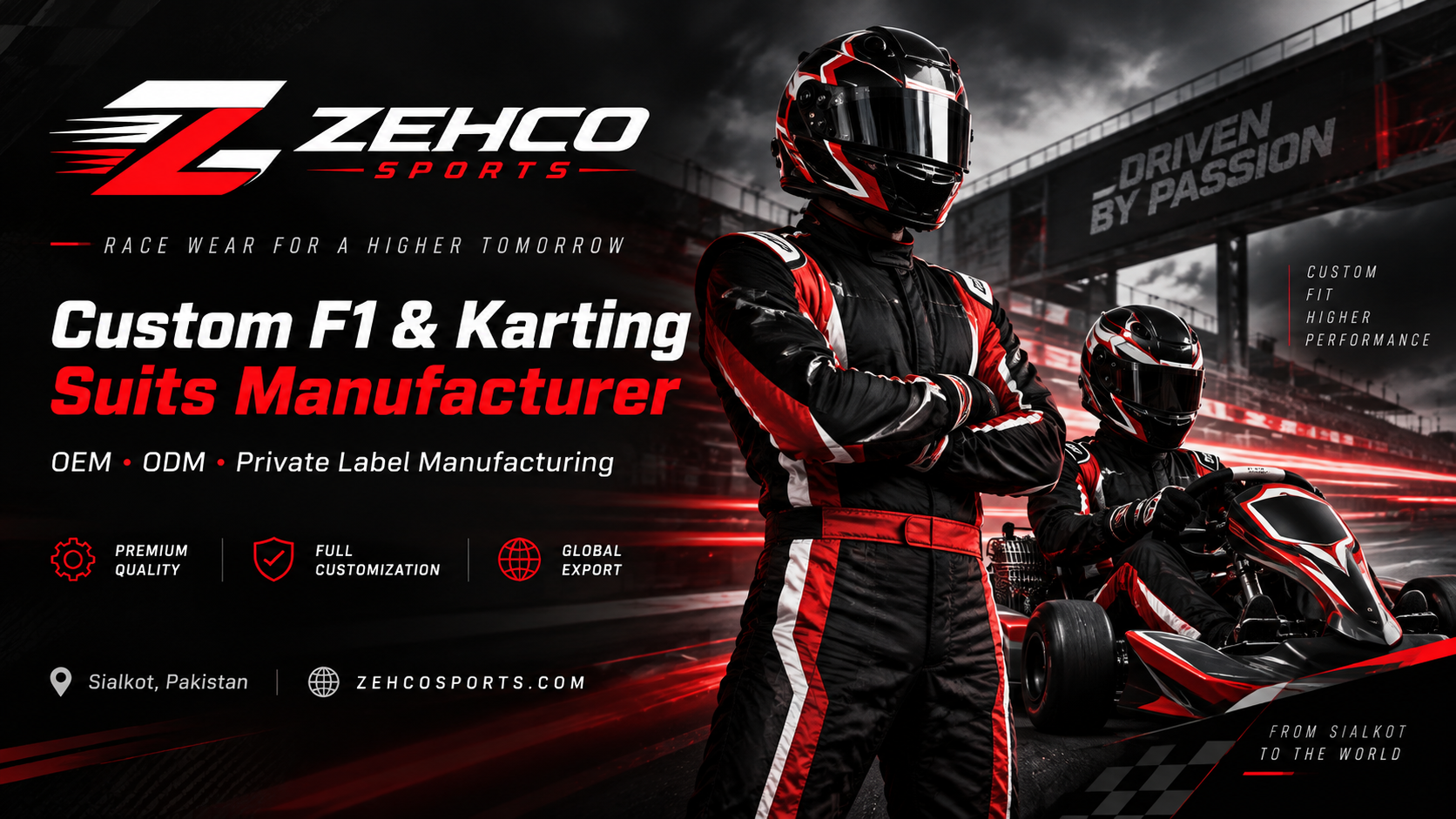
Choosing the right custom F1 and karting suits manufacturer is an important sourcing decision for motorsport brands, karting teams, distributors and private-label companies. A racing suit is more than a visually branded garment: buyers must evaluate fabric construction, mobility, sizing consistency, customization methods, stitching quality, production repeatability and packaging before placing a commercial order. ZEHCO Sports supports international motorsport buyers from Sialkot, Pakistan with OEM, ODM and private-label manufacturing for custom racing and karting apparel.
This guide explains the main considerations professional buyers should review when developing F1-style racing suits, go-karting suits and related motorsport apparel for their own brand, racing organization or distribution business.
Why Work With a Custom F1 and Karting Suits Manufacturer?
Working directly with a specialized manufacturer gives buyers greater control over product design, specifications and commercial presentation. Instead of purchasing generic finished suits from wholesalers, OEM buyers can develop a product around their own target market, sizing requirements, brand identity and price positioning.
A manufacturing partnership can also help brands maintain consistency across future orders. Once the fabric, patterns, measurements, colors, logos and construction details have been approved, the same specifications can be documented for repeat production. This is especially valuable for distributors and racing teams that need replacement suits or additional sizes during the racing season.
ZEHCO Sports works with buyers seeking custom manufacturing rather than limiting customers to fixed ready-made designs. Depending on the project, buyers can submit technical drawings, reference photographs, existing samples, brand guidelines or a general concept for development.
Understanding F1-Style Racing Suits and Karting Suits
Although F1-inspired racing suits and karting suits often share similar visual characteristics, the intended application should always be communicated clearly before product development begins. Materials, layers, reinforcement, ventilation, weight and finishing can vary according to the buyer's market and intended use.
Custom F1-Style Racing Suits
F1-style suits are commonly requested by motorsport apparel brands, racing clubs, promotional teams, simulation racing businesses and customers seeking professional-looking motorsport uniforms. Buyers may require one-piece constructions with prominent sponsor areas, contrast panels, shoulder details, belts, cuffs and customized embroidery or printed artwork.
The required specification should identify whether the suit is intended for professional competition, recreational use, promotional activities or merchandising. Buyers requiring compliance with a particular motorsport standard should specify the exact certification or technical requirement before ordering so that materials and construction can be reviewed against the intended application.
Custom Go-Karting Suits
Go-karting suits are widely sourced by kart racing teams, academies, rental karting facilities, motorsport brands and distributors. Important buyer considerations include flexibility around the shoulders and knees, comfortable internal construction, abrasion-resistant areas, ventilation options and durable branding.
Because karting teams may need suits for drivers of different ages and body proportions, size planning is particularly important. A supplier should be able to work from a defined size chart while also discussing customized measurements for team or individual orders when required.
Material Selection for Motorsport Racing Suits
Material choice has a direct effect on comfort, appearance, durability and production cost. There is no single fabric specification suitable for every racing apparel project, so buyers should define the intended market before requesting a quotation.
For karting and general motorsport apparel, manufacturers may work with durable woven fabrics and other performance-oriented textile constructions selected according to the desired weight and finish. Reinforcement may also be incorporated into areas exposed to frequent movement or abrasion.
When evaluating fabric options, buyers should consider:
- Fabric weight: lighter constructions may improve comfort, while heavier materials can provide a more substantial feel.
- Abrasion resistance: important for areas exposed to repeated contact and movement.
- Breathability: ventilation and fabric selection can influence driver comfort.
- Color stability: particularly important when matching team colors across repeat production.
- Surface compatibility: the fabric should be suitable for the selected embroidery, printing or patch application.
- Care requirements: buyers should understand washing and maintenance considerations before selecting material.
International buyers should request available fabric specifications or physical samples when material selection is commercially important. Evaluating a material before bulk production can reduce misunderstandings regarding texture, thickness, flexibility and appearance.
OEM Customization and Private-Label Branding
Customization is one of the main reasons brands source directly from a racing suit manufacturer. A professionally developed motorsport suit should integrate brand identity into the garment rather than simply adding a logo to a generic product.
Color and Panel Customization
Racing suits can be developed around team colors, sponsor requirements or an apparel brand's seasonal collection. Contrast panels, piping, shoulder sections, side panels, cuffs and belts can create a distinctive design language.
Before sampling, buyers should ideally supply color references such as Pantone information where accurate color matching is important. Digital screen colors should not be treated as an exact representation of physical fabric.
Embroidery, Printing and Sponsor Branding
Motorsport garments often contain multiple branding elements. These may include team names, driver names, sponsor logos, national flags, chest logos, back graphics and sleeve branding.
Depending on the design and material, branding can include embroidery, printed elements, woven or embroidered patches and other suitable application methods. The manufacturer should review artwork before production because extremely small text, complex gradients or very fine details may require adjustment for clean manufacturing.
Private Labels and Packaging
Private-label buyers can develop suits under their own commercial identity. Branding requirements may include neck labels, size labels, care labels, hangtags, branded packaging and other buyer-provided identification.
These details should be finalized before bulk production because labeling and packaging form part of the finished product specification. Consistent presentation is particularly important for wholesalers and brands supplying retailers or e-commerce customers.
Custom Sizing and Fit Development
Sizing is one of the most important areas in motorsport apparel sourcing. A technically attractive suit can still create customer complaints if fit varies between sizes or production batches.
Buyers should establish an approved measurement chart covering critical dimensions such as chest, waist, hip, shoulder, sleeve, inseam and total garment length. Measurements should also specify allowable manufacturing tolerances.
For team orders, buyers may submit individual driver measurements where personalized sizing is required. For retail collections, a standardized size range is normally more practical because it allows distributors to maintain inventory across common customer sizes.
Manufacturers should also consider mobility when developing the pattern. Drivers need sufficient movement in seated racing positions, particularly around the shoulders, arms, waist and knees. Fit evaluation should therefore consider the intended use of the garment rather than appearance only when standing.
The Sample Development Process
Sampling is one of the most valuable stages of an OEM racing suit project. It gives the buyer an opportunity to evaluate the physical product before committing to repeat or bulk production.
A typical development process can include confirmation of the design, selection of materials, preparation of artwork, agreement on measurements, production of a prototype and buyer feedback. Corrections can then be incorporated into an approved specification.
Buyers should review a sample for more than visual appearance. Important checks include:
- Overall fit and driver mobility
- Fabric feel and garment weight
- Logo placement and dimensions
- Embroidery or printing quality
- Stitching consistency
- Zipper operation
- Cuff and collar construction
- Panel alignment
- Label information
- Packaging presentation
Keeping the approved sample or detailed specification as a production reference helps both buyer and manufacturer maintain consistency during repeat orders.
Quality Control for Custom Motorsport Suits
Quality control should begin before the final inspection stage. A structured production process can identify problems earlier and reduce the risk of repeated defects across an entire order.
Material and Component Checks
Fabric, zippers, threads, labels and branding components should correspond with the approved specification before assembly. Changes in material can affect both appearance and fit, particularly when different fabric weights or stretch characteristics are introduced.
In-Process Sewing Inspection
During stitching, attention should be given to seam consistency, panel alignment, reinforcement and construction accuracy. Complex racing suit designs often combine several panels, colors and branding positions, so production control is important for maintaining uniform appearance.
Final Garment Inspection
Finished suits should be checked for measurements, stitching defects, loose threads, stains, artwork positioning, zipper function, labeling and overall presentation. Buyers requiring specific inspection criteria can communicate those requirements before production.
MOQ and Order Planning for International Buyers
Minimum order quantity is an important consideration for new brands and teams testing a product. Rather than focusing only on the lowest possible MOQ, buyers should discuss how quantity affects material procurement, customization, unit cost and production efficiency.
A small initial order may be suitable for product testing, market validation or a racing team's immediate requirements. Larger repeat orders can then be planned after the design, fit and customer response have been confirmed.
When requesting a quotation, buyers can help manufacturers provide more accurate pricing by sharing the expected quantity, size breakdown, number of designs, branding method, fabric requirements and packaging specifications.
What Information Should Buyers Send for a Racing Suit Quotation?
A detailed inquiry usually receives a more accurate quotation than a message requesting only a general price. Buyers sourcing custom motorsport suits should ideally provide as much of the following information as possible:
- Required product type: karting suit or F1-style racing suit
- Estimated order quantity
- Reference design, drawing or photographs
- Required fabric or intended product level
- Color combinations
- Brand and sponsor logos
- Preferred embroidery, print or patch details
- Size range and quantity per size
- Private-label requirements
- Packaging requirements
- Destination country
- Target delivery schedule
When the buyer does not yet have a complete technical specification, a manufacturer can use reference material as a starting point and identify the details that must be confirmed before sampling.
Planning Repeat Bulk Production
For distributors and growing apparel brands, the real value of a manufacturing relationship often appears after the first successful order. Repeatability becomes essential when customers expect the next production batch to match the previous one.
Buyers should maintain approved records for fabric, colors, patterns, measurements, artwork, labels and packaging. Changes should be documented rather than communicated informally. A structured specification reduces production ambiguity when an order is repeated months later.
Forecasting can also help. If a distributor expects seasonal demand or a racing team expects new members during the year, communicating approximate future quantities allows production requirements to be planned more effectively.
Why Source Custom Motorsport Wear From Sialkot, Pakistan?
Sialkot has a long-established manufacturing ecosystem serving international sports goods and apparel markets. For motorsport buyers, access to stitching, embroidery, printing, pattern development and garment finishing capabilities within the manufacturing region can support customized product development and export-oriented production.
ZEHCO Sports operates from Sialkot and focuses on custom sportswear and racing gear for international customers. The company's product scope includes motorcycle racing wear, racing gloves, jackets, motorsport suits, team sportswear and fight wear, allowing buyers to develop related categories through one manufacturing relationship.
Questions to Ask Before Selecting a Racing Suit Supplier
Before confirming a manufacturer, international buyers should ask practical questions about the development and production process. Useful areas to discuss include:
- Can the manufacturer work from custom artwork or physical samples?
- What materials are available for the intended application?
- Can a prototype be developed before bulk production?
- How are measurements and size tolerances controlled?
- Which branding techniques are available?
- Can custom labels, hangtags and packaging be produced?
- How is quality checked during and after manufacturing?
- Can specifications be retained for repeat production?
- What information is required to calculate lead time and pricing?
- What export documentation and shipping support can be provided?
These questions help buyers compare manufacturers on production capability and process reliability instead of making a decision based only on unit price.
Common Sourcing Mistakes to Avoid
One common mistake is placing a bulk order before approving materials, measurements and branding details. Another is sending low-quality logo files that cannot be reproduced cleanly through embroidery or printing.
Buyers should also avoid changing specifications after production has started. Late changes to colors, measurements, logos or packaging can affect production efficiency, cost and completion schedules.
Finally, buyers should distinguish between promotional motorsport apparel and products intended to meet specific competition requirements. Where certification or regulatory compliance is required, the exact applicable standard should be communicated and verified before ordering rather than assumed from the appearance of the suit.
Build Your Custom Motorsport Collection With ZEHCO Sports
Selecting a reliable custom F1 and karting suits manufacturer requires evaluation of much more than price. International buyers should review materials, fit development, customization capabilities, sample quality, branding accuracy, production controls and the supplier's ability to reproduce the same specification across future orders.
ZEHCO Sports provides OEM, ODM and private-label manufacturing support from Sialkot, Pakistan for motorsport brands, racing teams, distributors, clubs and sourcing companies. Buyers can develop custom karting suits, F1-style racing apparel and complementary motorsport products using their own designs, colors, logos, sizing and branding specifications.
For an accurate manufacturing quotation, buyers should send their reference design, required quantities, size breakdown, branding requirements and destination market through the ZEHCO Sports website. A clear specification at the beginning of the project creates a stronger foundation for sampling, bulk production and long-term repeat sourcing.