Choosing a custom fight wear manufacturer involves more than comparing designs and unit prices. MMA shorts must support unrestricted movement, rash guards need an agreed close-fitting size profile, and boxing apparel must balance mobility with brand presentation. For international apparel brands, distributors and fight teams, the sourcing process should turn these requirements into measurable specifications before bulk production begins.
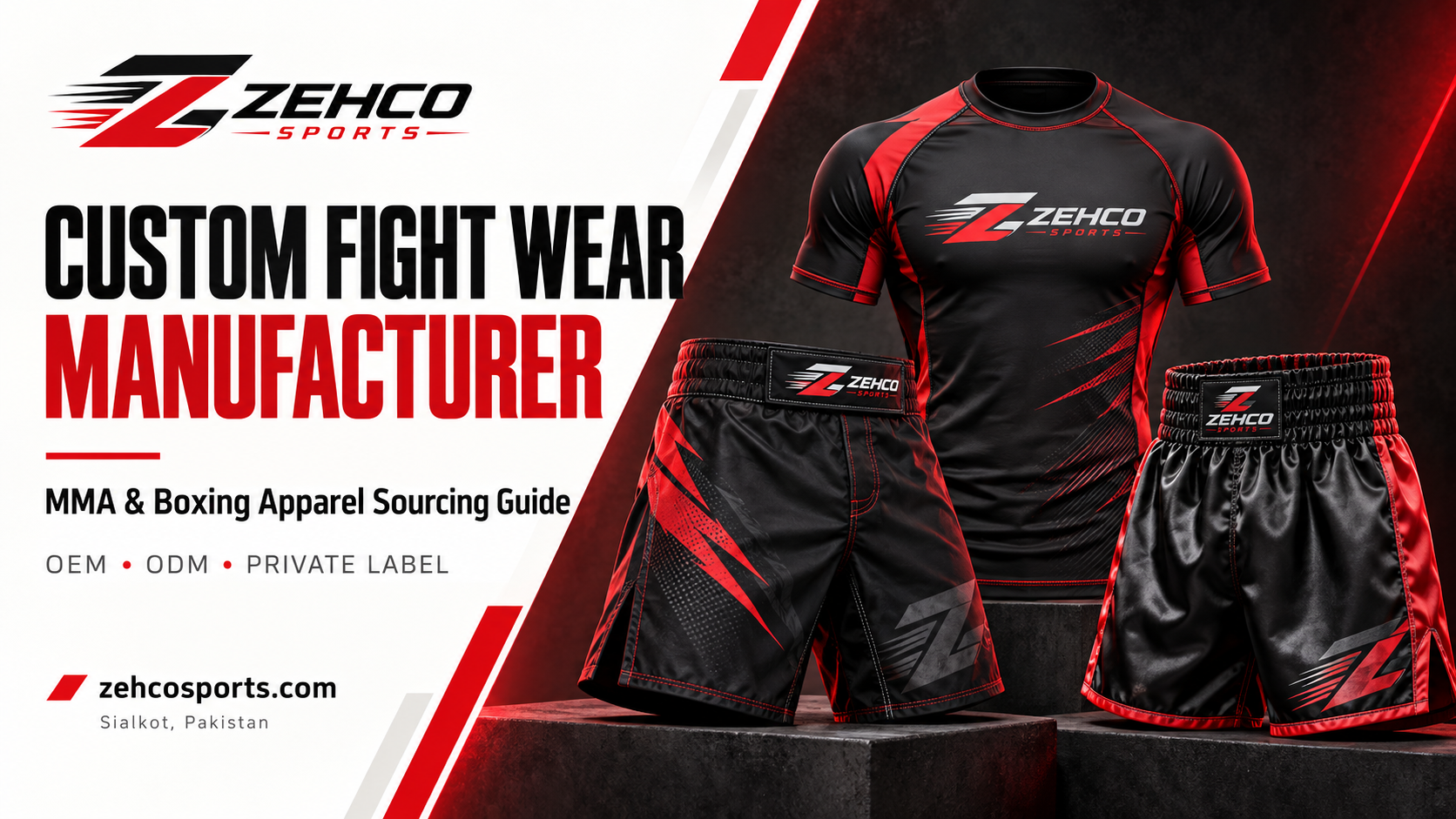
ZEHCO Sports provides OEM, ODM and private-label manufacturing support from Sialkot, Pakistan. Its fight wear range includes MMA shorts, rash guards, compression shirts, boxing shorts, boxing robes, BJJ wear and wrestling singlets. This guide explains how buyers can define a collection, assess samples and prepare repeat orders with fewer avoidable inconsistencies.
Define Your Fight Wear Collection Before Requesting Prices
Start with the intended wearer and use. A gym merchandise collection, a distributor’s wholesale range and an athlete’s competition kit can require different fits, decoration methods and ordering schedules. Identify whether each garment is intended for training, competition or promotional use, then specify the conditions in which it will be worn.
MMA Shorts and Grappling Apparel
For MMA shorts, define the waistband construction, closure system, inseam, leg opening and preferred stretch direction. Ask sample wearers to perform squats, lunges and high knee movements to identify restriction or waistband movement. For grappling garments, review whether exposed fasteners, loose details or bulky seams could interfere with partner training.
Boxing Shorts and Robes
Boxing shorts require decisions on rise, waistband height, leg width and overall length. Robes need separate measurements for sleeve length, body length, belt position and hood construction where applicable. Specify athlete names and sponsor graphics individually, because personalized artwork can affect preparation time and order accuracy.
How to Evaluate a Custom Fight Wear Manufacturer
Evaluate a supplier against your actual product specification. Request examples of comparable garment construction and ask how the manufacturer records sample changes, controls measurements and identifies approved materials. A visually attractive sample is useful, but buyers also need a documented process for reproducing it across sizes and subsequent orders.
- Development support: Can the supplier work from your technical pack, reference garment or initial design brief?
- Material identification: Will the quotation identify fabric composition, weight and relevant finishes?
- Fit control: How are size charts, measurement tolerances and grading instructions recorded?
- Approval process: Which sample establishes the final standard for bulk production?
- Repeatability: How are patterns, artwork and material changes managed for reorders?
Specify Materials by Performance Requirements
Descriptions such as “premium stretch fabric” leave too much room for interpretation. Request the proposed fiber composition, fabric weight in grams per square metre, surface finish and stretch characteristics. These details provide a common basis for comparing quotations and checking whether the delivered material matches the approved sample.
Rash Guards and Compression Shirts
For close-fitting tops, assess stretch recovery, coverage when stretched, seam comfort and garment movement during training. Approve the intended fit explicitly: a fitted rash guard and a tighter compression-style shirt should not automatically share the same measurements. Request evidence before adding specific compression, antibacterial or other performance claims to product descriptions.
Shorts and Boxing Apparel
For shorts, assess fabric flexibility alongside waistband stability and seam construction. Where stretch panels are proposed, record their placement and material separately from the main fabric. For boxing apparel, compare physical swatches for weight, sheen and feel; photographs alone provide a limited basis for approving surface appearance.
Create a Technical Pack That Supports Accurate Quotations
A technical pack gives both parties a shared production reference. Include front and back drawings, construction notes, a measurement chart, material requirements and artwork placement. Assign a style code and revision number so that pricing, sampling and production discussions refer to the same version.
- Garment details: Product type, intended use, fit description and size range.
- Materials and trims: Main fabric, secondary panels, elastic, closures, thread and labels.
- Measurements: Defined measuring points, units and acceptable tolerances.
- Branding: Artwork files, color references, logo dimensions and placement distances.
- Order breakdown: Quantities by style, color, size and personalization requirement.
- Presentation: Label text, hangtags, individual packaging and carton instructions.
If a complete technical pack is unavailable, provide reference photographs and a physical garment where possible. Mark which features should be retained and which should change. Ask the manufacturer to document the resulting specification for approval before proceeding.
Match Branding Methods to Garment Construction
Select decoration methods alongside the fabric and pattern. Ask the manufacturer to confirm which printing, sublimation, embroidery or patch options suit the proposed material and placement. A large decorative element on a flexible panel may affect how that area stretches or feels against the body.
Approve artwork on the actual sample, including its appearance when worn. Check logo proportions, lettering clarity, panel alignment and visibility across seams. Personalized team orders should include a separate name-and-size list, with spelling approved before production begins.
Validate Fit Across the Size Range
Size labels alone are insufficient for international sourcing. Define whether your chart contains body measurements or finished garment measurements, and show how each point is measured. For elasticated areas, distinguish relaxed measurements from measurements taken under an agreed stretching method.
Review a size set covering the range, especially the smallest and largest sizes. Ask representative wearers to assess movement, waistband security and garment length. Record feedback as measurable changes, such as increasing sleeve length by a specified amount, instead of subjective instructions such as “make the fit better.”
Use Sampling to Establish the Bulk Production Standard
Agree on the purpose of each sample stage. An initial development sample may resolve shape and construction, while a pre-production sample should represent the materials, artwork, trims and finishing intended for the order. Record any outstanding differences before approving production.
- Measure the garment against the agreed specification.
- Inspect seams, closures, elastic and decoration placement.
- Conduct movement checks appropriate to the garment’s intended use.
- Wash the sample using the proposed care instructions and reassess dimensions and appearance.
- Document required revisions with photographs and precise comments.
- Retain an approved reference sample for comparison with bulk goods.
A buyer’s sample review helps identify practical issues but does not establish every possible performance claim. Where a particular test result is required, specify the test, acceptance criteria and reporting responsibility separately.
Clarify MOQ, Pricing and Production Timing
Ask whether the minimum order quantity applies per style, color, fabric or total order. A collection containing several low-volume designs can have different production requirements from one design ordered in larger quantities. Confirm size allocation rules and whether personalized pieces carry separate charges.
Request an itemized quotation covering garments, sampling, artwork preparation, labels, packaging and shipping where applicable. Establish when the production lead time starts and which approvals must be completed first. Keep production completion, shipment departure and expected delivery as separate milestones when planning a launch.
Set Quality Checks and Packing Instructions Before Production
Agree on checks for measurements, seam integrity, shade consistency, artwork accuracy and overall finishing. Define how defects will be recorded and resolved before shipment. For multi-size orders, verify quantities against the approved size breakdown rather than checking only the total number of garments.
Packaging instructions should connect each item to its style, color and size. Provide barcode files if required, specify carton assortment rules and agree on carton markings. Accurate packing records help distributors receive stock and help teams locate personalized garments without opening every package.
Keep Repeat Orders Consistent
Maintain an approved production record containing the pattern revision, material specification, artwork version, measurement chart and packaging details. Reference that record on every reorder. Ask for proposed substitutions to be disclosed before production, and review a new sample when a change could affect fit, appearance or performance.
Start Your Fight Wear Project with ZEHCO Sports
Send ZEHCO Sports your product list, reference designs, estimated quantities, size requirements and destination country. Include your target launch date and explain whether you need OEM production from existing specifications or development support for a new private-label collection. These details help establish suitable options and a project-specific quotation.
A dependable sourcing process makes expectations measurable before money is committed to bulk inventory. When selecting a custom fight wear manufacturer, prioritize clear specifications, practical sample evaluation and documented approvals. Contact ZEHCO Sports to discuss your MMA or boxing apparel project and confirm materials, MOQ, sampling and production requirements.