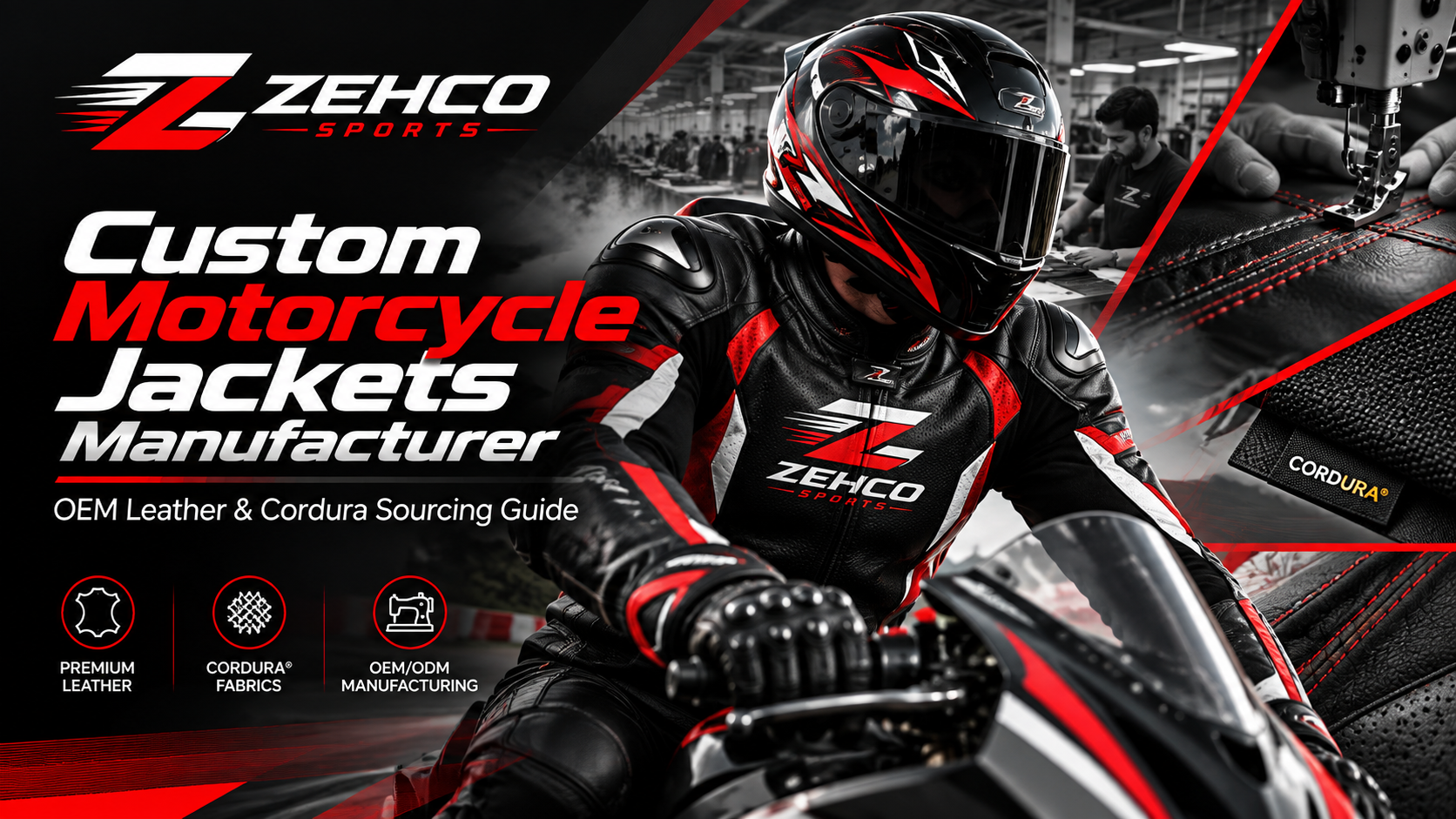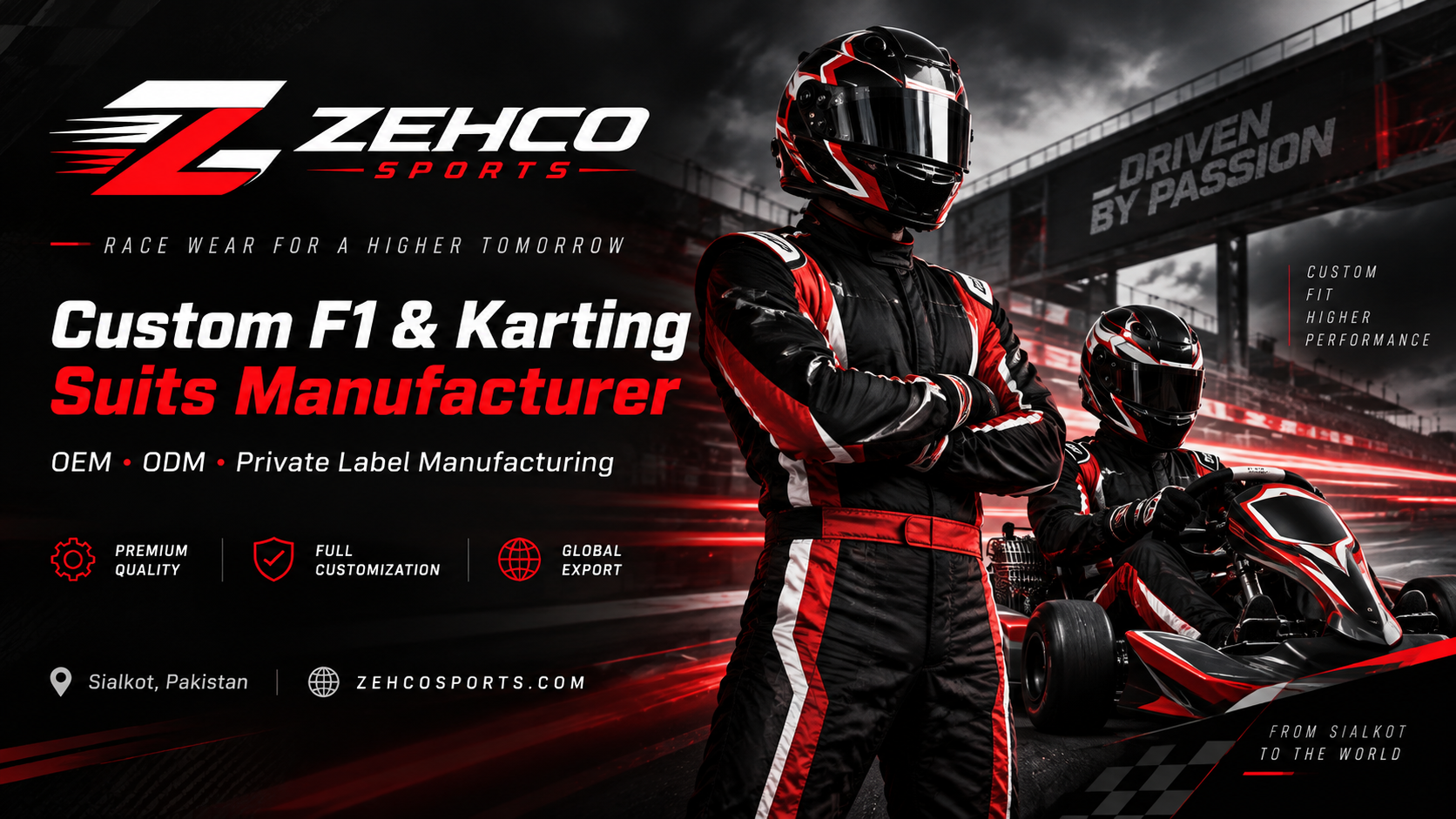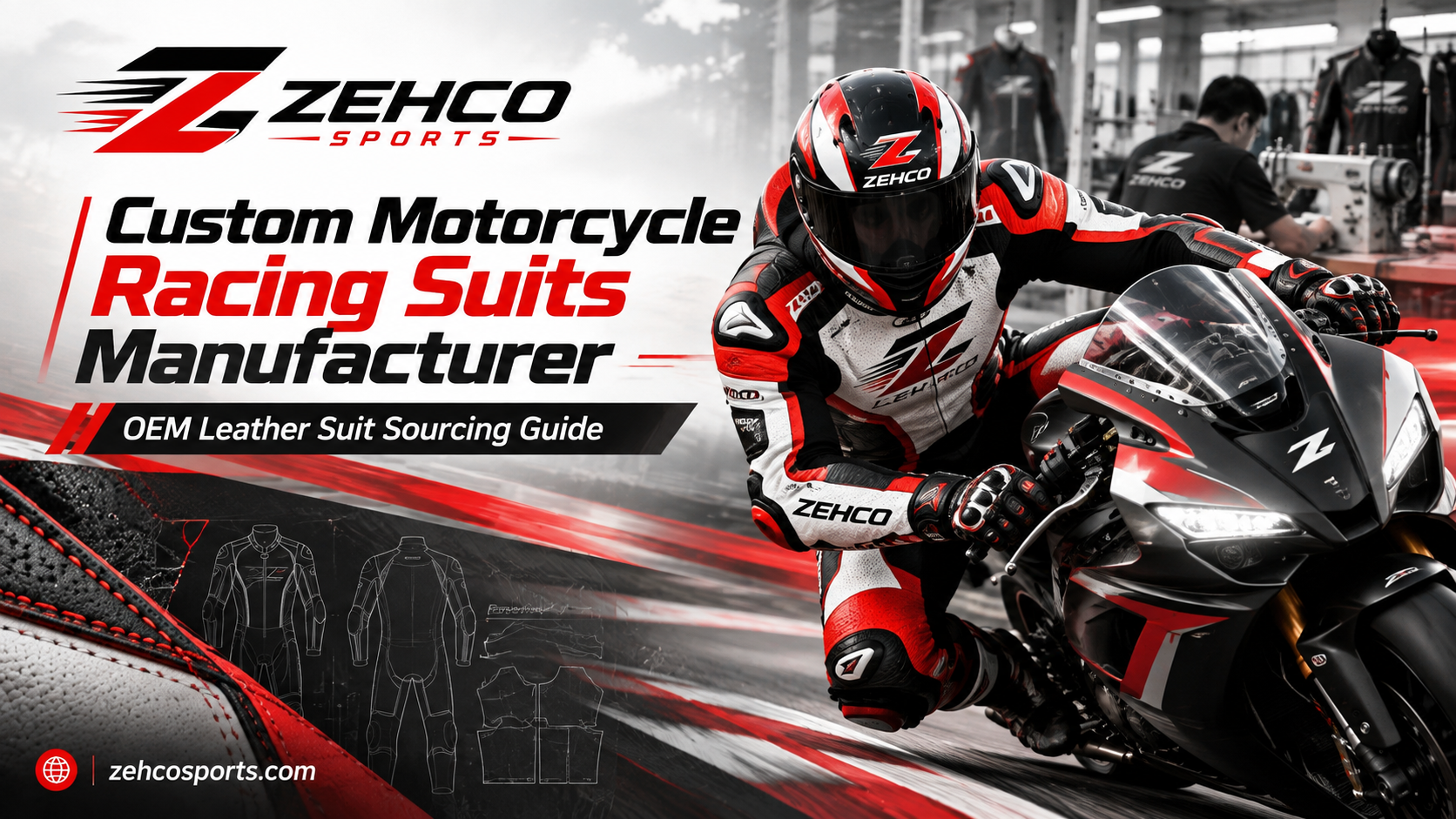
Choosing the right custom motorcycle racing suits manufacturer is a critical sourcing decision for motorcycle apparel brands, racing teams, distributors and importers. A racing suit must combine abrasion-resistant materials, rider mobility, protective component integration, accurate sizing and consistent branding while remaining commercially viable for repeat production. ZEHCO Sports, based in Sialkot, Pakistan, supports international buyers with OEM, ODM and private-label motorcycle racing wear manufacturing for both developing brands and established wholesale customers.
What International Buyers Should Expect from a Custom Motorcycle Racing Suits Manufacturer
A professional manufacturer should do more than reproduce a visual design. Motorcycle racing suits are technical garments in which leather thickness, panel placement, stretch zones, reinforcement areas, stitching construction, protectors and rider ergonomics all influence the finished product. International buyers therefore need a supplier capable of converting a concept, reference sample or technical specification into a production-ready garment.
For OEM buyers, the manufacturing process normally begins with design review and specification confirmation. Important details include whether the suit will be one-piece or two-piece, the intended rider category, required leather type, color combinations, branding positions, protector requirements, perforation preferences, stretch panels and size range. Establishing these specifications before sampling reduces unnecessary revisions and creates a clearer basis for bulk production.
One-Piece and Two-Piece Motorcycle Racing Suits
One-Piece Racing Suits
One-piece motorcycle racing suits are commonly developed for track riding, racing teams and performance-focused motorcycle brands. Their continuous construction reduces separation between jacket and trousers and allows the manufacturer to engineer the garment around an aggressive riding position. Buyers developing one-piece suits should pay particular attention to torso length, shoulder movement, knee position, sleeve rotation and the relationship between leather and stretch zones.
Two-Piece Racing Suits
Two-piece motorcycle suits provide additional flexibility for road riders, touring customers and brands targeting consumers who want separate jacket and trouser use. The jacket and trousers can be designed with a connection zipper so they function together when required. For private-label programs, buyers should specify the zipper configuration, waist overlap, jacket length and compatibility between upper and lower sections during product development.
Leather Selection for Motorcycle Racing Suit Manufacturing
Leather is one of the most important sourcing decisions when developing motorcycle racing apparel. Cowhide is widely used because it offers a strong balance of abrasion resistance, structural stability, availability and cost. Depending on the product specification, manufacturers can develop suits using different leather grades, thicknesses, finishes and treatments.
International buyers should avoid specifying leather only by generic descriptions such as “genuine leather.” A professional specification should address leather type, target thickness, finish, softness, grain appearance, color consistency and performance expectations. Material specifications should be agreed before bulk cutting because variations in leather can affect garment appearance, weight, flexibility and manufacturing consistency.
Buyers should also consider how leather selection relates to their market position. A premium racing brand may prioritize selected hides, cleaner surface appearance and more detailed finishing, while a commercial-volume program may require a carefully controlled balance between durability and target price. The manufacturer should understand these priorities before sample development begins.
Stretch Panels, Mobility and Rider Ergonomics
A motorcycle racing suit cannot rely entirely on rigid leather construction. Riders need flexibility when leaning forward, bending their knees, moving their shoulders and changing body position during riding. Manufacturers therefore integrate stretch materials and accordion-style leather panels in selected areas to improve mobility.
Common stretch areas include the crotch, inner legs, underarms and sections behind the knees. Accordion leather panels may also be positioned near the lower back, shoulders or knees depending on the design. Correct placement is important because excessive stretch material may reduce the protective leather coverage, while insufficient flexibility can make the suit uncomfortable in an aggressive riding posture.
For OEM projects, buyers should review not only how the sample looks when standing but also how it performs in a realistic riding position. Fit assessment should include reach to handlebars, knee bending, shoulder movement and overall torso flexibility.
Protection Integration and Reinforcement Areas
Motorcycle racing suits are commonly designed with dedicated areas for protective components at the shoulders, elbows, knees and other impact zones. Depending on the buyer's specification, suits may include internal protector pockets, external sliders or reinforcement structures.
Protection requirements should be documented clearly at the quotation and sampling stage. If a buyer requires specific third-party protectors or components meeting particular standards, those requirements should be confirmed separately before production. Manufacturers should not assume that every armor component, construction method or material automatically meets a particular certification requirement.
High-wear areas may also require additional leather layers or reinforcing materials. The exact construction depends on the target application, design and price level. For international brands, documenting these reinforcement areas in a technical specification helps ensure that approved sample construction is reproduced in bulk production.
Perforated and Non-Perforated Leather Racing Suits
Climate and intended riding conditions influence whether buyers choose perforated or non-perforated leather. Perforated leather allows greater airflow and is often requested for warmer markets or track-focused products. Non-perforated construction may be preferred where reduced airflow or a different seasonal positioning is required.
Brands can also combine perforated and solid panels strategically rather than using one treatment throughout the complete garment. This approach allows ventilation to be concentrated in specific areas while maintaining the desired construction elsewhere.
Before ordering, buyers should identify their primary sales markets and customer use cases. A suit intended for hot-weather riders in the Middle East may require a different ventilation strategy from a product developed primarily for cooler European conditions.
Custom Branding and Private-Label Options
Brand presentation is a major part of private-label motorcycle racing wear. Customization can include brand logos, sponsor graphics, racing numbers, rider names, team identities and decorative design elements. Depending on the design, manufacturers may use leather appliqué, embroidery, printed graphics, patches or other suitable branding methods.
Buyers should supply vector logo files whenever possible because high-quality source artwork improves accuracy during production. The technical pack should specify the exact logo position, dimensions, colors and production method. This is particularly important for racing teams where multiple sponsor logos must be arranged consistently across several suits.
For distributors and apparel brands, private labeling can extend beyond exterior logos. Projects may include custom neck labels, size labels, care labels, packaging, hangtags and branded cartons. These elements should be discussed early because they can affect sampling, minimum quantities and production lead times.
Custom Colors and Design Development
Motorcycle racing suits frequently use complex combinations of leather colors, contrast panels and graphics. Buyers can provide sketches, reference images, existing garments or complete technical packs. A manufacturer then evaluates whether the proposed design can be converted efficiently into production patterns.
Design development should consider more than visual appearance. Excessively complicated panel structures can increase cutting, stitching and assembly requirements, while extremely small leather panels may create production challenges. A good OEM development process balances branding goals with manufacturing practicality.
For emerging brands without complete technical files, a reference design can serve as a starting point, but specifications should still be documented before production. Buyers should confirm measurements, colors, branding, materials and construction details rather than relying solely on photographs.
Motorcycle Racing Suit Sizing and Fit Development
Sizing is one of the most important factors in motorcycle apparel manufacturing. Racing suits fit differently from casual jackets or conventional fashion garments because the product must accommodate a riding posture, protective components and movement requirements.
International buyers should decide whether they want to use their existing brand size chart, develop a new measurement specification or modify a manufacturer's base sizing. Critical measurements can include chest, waist, hip, inseam, sleeve length, shoulder width, torso length and overall body height.
For team orders or professional riders, individual made-to-measure specifications may also be considered where commercially appropriate. Measurements must be collected consistently because incorrect measurement methods can result in fit problems even when manufacturing follows the supplied data accurately.
Why Pre-Production Sampling Matters
A sample is not simply a demonstration piece; it is an important technical reference for bulk manufacturing. Buyers should use the sampling stage to evaluate material feel, pattern shape, overall fit, logo placement, color combinations, zipper operation, stitching, stretch zones and protector positioning.
Feedback should be specific. Instead of requesting that a suit be “more comfortable,” buyers should identify which dimension or area requires adjustment. Similarly, branding revisions should include exact measurements or revised artwork rather than general instructions.
Once the sample is approved, the confirmed construction and specifications should become the reference for bulk production. If significant changes are introduced after approval, they may require additional sampling or revised pricing.
MOQ Considerations for OEM Motorcycle Racing Suits
Minimum order quantity can vary according to design complexity, material availability, customization level, size breakdown and branding requirements. A simple repeated design may be easier to manufacture in smaller commercial quantities than an order containing numerous unique colorways, custom trims and individualized rider specifications.
Buyers should therefore provide complete information when requesting an MOQ and quotation. A useful inquiry includes required quantity, suit type, leather preference, size range, target market, branding requirements, reference images and destination country.
This allows the manufacturer to assess the actual production requirements instead of providing an inaccurate generic price based only on the words “motorcycle racing suit.”
Quality Control During Racing Suit Production
Consistent bulk manufacturing requires inspections at several production stages rather than relying only on a final visual check. Material checking should take place before cutting. Leather panels should be assessed for acceptable appearance and consistency according to the agreed quality level.
During stitching and assembly, manufacturers should monitor seam construction, panel alignment, branding placement, zipper installation and component positioning. Finished garments should then be checked against the approved specification, including sizing, visible workmanship and required accessories.
For repeat orders, maintaining documented specifications is especially valuable because international brands expect continuity between production batches. When materials or components must change because of availability, those changes should be discussed with the buyer rather than substituted without approval.
Packaging for International Wholesale Orders
Packaging should protect finished racing suits during storage and international transportation while supporting the buyer's retail or distribution requirements. Packaging specifications can include individual protective bags, size identification, branded tags, carton quantities and shipping marks.
Importers should communicate any country-specific labeling requirements before production. Retail brands may also request barcode labels or customized packaging elements that need to be coordinated with their inventory systems.
Efficient carton planning is another important consideration because motorcycle leather apparel can be relatively heavy and bulky. Packaging dimensions and shipment configuration can influence freight costs, particularly when goods are transported internationally by courier, air freight or sea freight.
OEM, ODM and Private-Label Production with ZEHCO Sports
ZEHCO Sports supports multiple sourcing models depending on the buyer's development requirements. Under OEM production, buyers can provide their own designs and specifications for manufacturing. Private-label customers can manufacture products under their own brand identity, including customized logos, labels and packaging.
ODM development can be relevant when buyers require manufacturing support in translating a concept into a practical product specification. In every case, clearly defining the product before production helps control quality, cost and communication.
ZEHCO Sports operates from Sialkot, Pakistan, a manufacturing center known internationally for sports goods and performance apparel production. The company's export-oriented approach is designed for brands, importers, racing teams, distributors and sourcing professionals requiring customized manufacturing rather than generic retail products.
Information to Include When Requesting a Quotation
A detailed inquiry enables a motorcycle racing wear manufacturer to provide more meaningful pricing and production information. Buyers preparing an RFQ should ideally include:
- Required product type: one-piece or two-piece racing suit
- Estimated order quantity
- Reference pictures, sketches or technical drawings
- Required leather type and preferred thickness
- Perforated or non-perforated construction
- Required size range and size chart
- Logo artwork and branding locations
- Protector or reinforcement requirements
- Custom labels, tags and packaging requirements
- Destination country and preferred shipping method
Providing these details from the beginning reduces repeated correspondence and makes it easier to compare quotations on an equivalent specification.
Key Questions to Ask Before Choosing a Supplier
International buyers should evaluate a supplier's manufacturing process rather than choosing purely on unit price. Useful questions include whether the manufacturer can develop patterns from technical specifications, how sample revisions are handled, what leather options are available, how branding is applied, what quality inspections take place and how repeat orders are controlled.
Buyers should also clarify production lead times, payment arrangements, packaging, shipment terms and procedures for approving materials. If certification or a specific performance standard is mandatory for the target market, the buyer should state the exact requirement and request appropriate documentation instead of assuming compliance based on general product descriptions.
A lower quotation can become expensive if poor communication results in incorrect materials, sizing errors, inconsistent branding or delayed deliveries. For B2B sourcing, manufacturing reliability and specification control should therefore be considered alongside pricing.
Conclusion: Work with a Custom Motorcycle Racing Suits Manufacturer
Selecting a reliable custom motorcycle racing suits manufacturer requires careful evaluation of materials, technical construction, sizing, customization, sampling, quality control and repeat-production capability. International motorcycle brands, distributors and racing teams benefit from providing detailed specifications and approving a physical sample before moving into larger production quantities.
ZEHCO Sports provides OEM, ODM and private-label motorcycle racing wear manufacturing from Sialkot, Pakistan, with support for custom leather racing suits, branding, colors, sizing and export-focused bulk production. Buyers planning a new racing apparel collection can contact ZEHCO Sports with their design references, required quantities, sizing specifications and branding requirements to begin the quotation and sample development process.