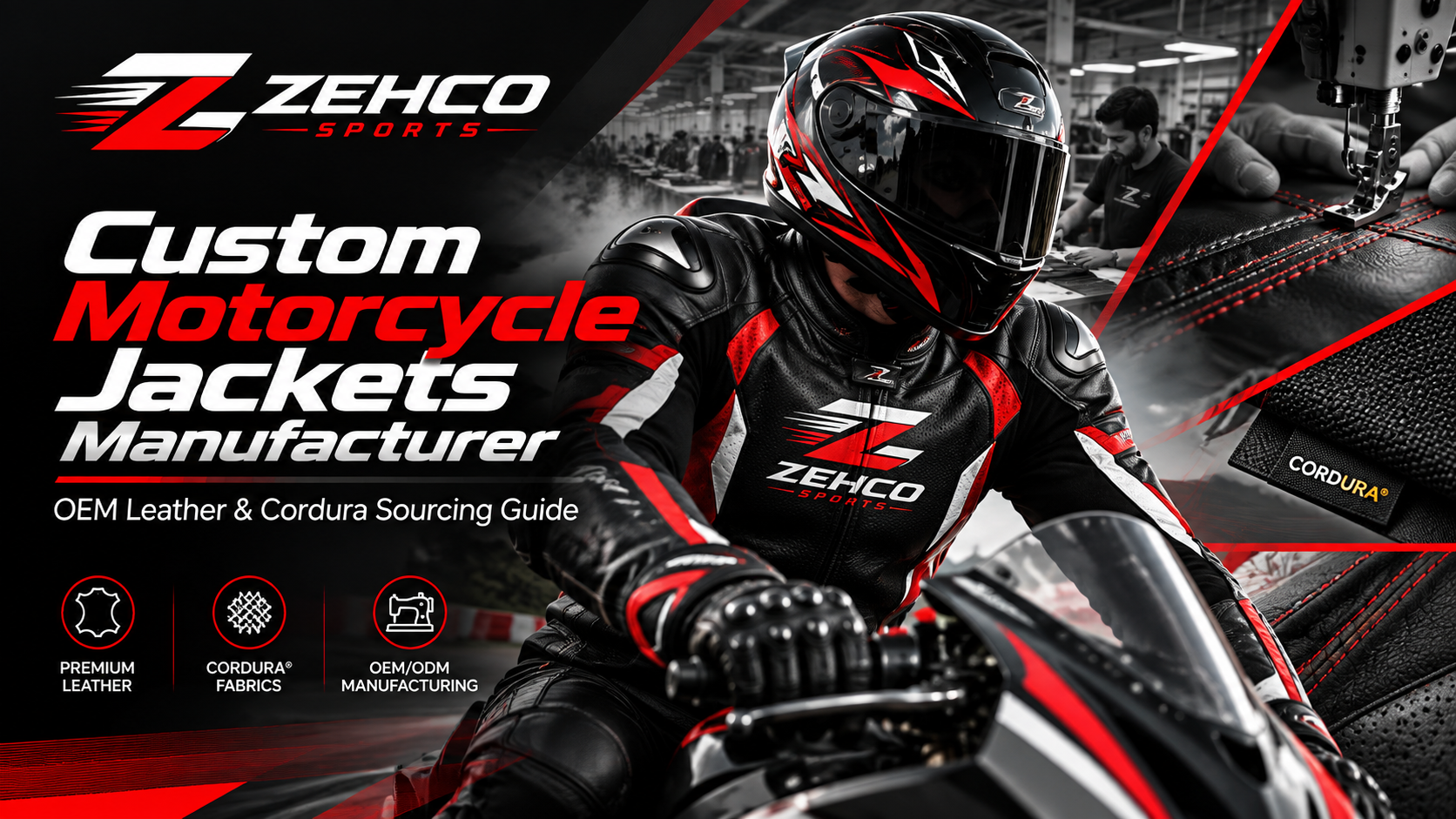
Choosing the right custom motorcycle jackets manufacturer is an important sourcing decision for motorcycle apparel brands, distributors, racing suppliers and private-label companies. A motorcycle jacket must combine appearance, rider comfort, abrasion-resistant materials, protective features, accurate sizing and consistent manufacturing. For international buyers, the challenge is not simply finding a factory capable of stitching a jacket, but finding a production partner that can translate a technical specification or reference design into repeatable commercial production.
ZEHCO Sports is based in Sialkot, Pakistan and supports OEM, ODM and private-label manufacturing for international buyers. Motorcycle jackets can be developed in leather, Cordura and other textile constructions according to the buyer's design, intended market, branding requirements and performance specifications. This guide explains the key factors buyers should evaluate before ordering samples or placing bulk motorcycle jacket production.
What to Expect From a Custom Motorcycle Jackets Manufacturer
A professional manufacturing relationship normally begins with product development rather than immediate bulk production. Buyers may provide technical packs, sketches, measurement charts, reference samples, photographs, artwork or a combination of these materials. The manufacturer's role is to convert those requirements into a workable jacket specification while identifying construction details that require clarification before sampling.
Important development information includes the jacket style, outer-shell material, lining, protective areas, ventilation system, closure type, pocket configuration, reflective details, branding locations and target size range. Buyers should also specify whether the product is intended for road riding, touring, urban motorcycle use, racing-inspired retail collections or general motorcycle fashion because each segment may require a different balance of protection, weight, mobility and appearance.
Leather vs Cordura Motorcycle Jackets
Leather Motorcycle Jackets
Leather remains widely used for motorcycle jackets because of its abrasion resistance, premium appearance and association with professional motorcycle equipment. Buyers commonly evaluate cowhide and other leather options according to thickness, finish, softness, grain consistency, color and intended performance level.
A heavier construction may suit performance-oriented motorcycle apparel, while a softer or more flexible leather specification may be preferable for lifestyle-oriented collections. The correct selection depends on the target customer and product positioning rather than simply selecting the thickest material available.
International buyers should establish acceptable leather characteristics before production. Color consistency, surface appearance, thickness tolerance and panel matching should be discussed during sample approval because natural leather can contain variations that must be controlled through grading and cutting procedures.
Cordura and Textile Motorcycle Jackets
Textile motorcycle jackets provide manufacturers with greater flexibility in weight, ventilation, weather-resistant construction and design complexity. Cordura-type fabrics and other abrasion-resistant textile materials can be combined with mesh panels, reinforcement zones, removable liners and ventilation openings depending on the buyer's specification.
Textile construction may also be suitable for brands that want multiple color combinations or highly visible panel designs. Buyers should confirm fabric composition, weight, coating, abrasion requirements and reinforcement areas before approving the sample because two fabrics with a similar visual appearance can perform very differently in actual use.
Protective Construction and Reinforcement Areas
Motorcycle jackets often require additional construction around areas exposed to impact or abrasion. Shoulders, elbows, forearms and upper-back areas commonly receive reinforced paneling or provisions for protective inserts.
If removable protectors are required, the buyer should specify protector pocket dimensions, positioning and compatibility requirements. The placement must remain stable when the rider moves, while still allowing the protector to be removed for garment cleaning or replacement where applicable.
Seam construction is equally important. A visually attractive jacket can still become unsuitable for performance-oriented buyers when seam strength, panel alignment or reinforcement is inconsistent. Buyers should therefore include critical seam requirements in their specification rather than evaluating only exterior appearance.
Fit, Ergonomics and Motorcycle Riding Position
Motorcycle jackets should not be developed in the same way as ordinary casual jackets. Riding posture changes the relationship between sleeve length, shoulder movement, back coverage and waist position. A jacket that looks correct when standing may become uncomfortable when the rider reaches toward motorcycle handlebars.
Design considerations may include pre-curved sleeves, stretch panels, adjustable waist systems, extended rear sections, accordion leather zones or flexible textile panels. These features can help improve mobility depending on the intended motorcycle application.
International buyers should provide a complete measurement chart whenever possible. Measurements should define chest, waist, shoulder, sleeve, jacket length and other critical dimensions for every size. If the buyer is entering a new market, it is also useful to review whether the proposed sizing corresponds with the body profiles of customers in that region.
OEM and Private-Label Branding Options
Private-label motorcycle apparel requires consistent brand presentation across the complete product. Buyers may request embroidered logos, printed branding, rubber patches, woven labels, leather patches, reflective logos, heat-transfer graphics or other customized applications.
Branding should be evaluated during the sample stage because logo placement can affect seams, panel dimensions and construction order. A large embroidered logo, for example, may need to be applied to a panel before final jacket assembly.
Typical private-label customization can include:
- Custom brand logos and artwork
- Woven main labels and size labels
- Custom zipper pullers
- Rubber or PVC badges
- Embroidered chest, sleeve or back logos
- Reflective branding elements
- Custom lining prints
- Hang tags and barcode labels
- Individual retail packaging
- Buyer-specific carton markings
Providing artwork in vector format helps improve accuracy when manufacturing embroidered patches, printed logos and other branded components.
How Motorcycle Jacket Sampling Should Work
Sampling is one of the most important stages in OEM motorcycle jacket development. The first sample allows both buyer and manufacturer to verify design interpretation, dimensions, materials, construction and branding before bulk production begins.
Buyers should review samples systematically instead of providing general comments such as "make it better" or "fit needs improvement." Clear comments should identify the exact area requiring modification, the current measurement or construction, and the requested revision.
A useful sample evaluation should cover:
- Overall appearance and panel proportions
- Material quality and approved colors
- Chest, waist and sleeve measurements
- Riding-position comfort
- Shoulder and elbow protector positioning
- Zipper quality and operation
- Pocket dimensions and accessibility
- Ventilation placement
- Lining and internal finishing
- Logo size, color and positioning
- Stitching consistency
Once modifications are agreed, the updated specification should become the reference for production rather than relying only on informal messages or photographs.
MOQ and Bulk Motorcycle Jacket Production
Minimum order quantity depends on jacket complexity, materials, colors, branding and component requirements. A customized motorcycle jacket using special leather colors, unique zippers or buyer-specific hardware may require a different production quantity from a standard textile jacket using readily available materials.
Buyers planning several designs should discuss how MOQ applies to each style, color and size assortment. Clarifying this early can prevent a situation where the total order quantity appears sufficient but individual variants fall below workable production levels.
For repeat orders, maintaining an approved specification is especially important. Materials and components should be referenced by clear descriptions or internal codes so future production can be matched as closely as possible to the previous approved order.
Quality Control for Motorcycle Jacket Manufacturing
Quality control should take place throughout production rather than only after garments are packed. Incoming materials, cutting, stitching, component attachment, measurements, finishing and packaging can all affect the final product.
Key inspection points may include material consistency, panel matching, seam alignment, skipped stitches, zipper operation, protector pocket positioning, logo accuracy, garment measurements and overall cleanliness.
Buyers placing recurring orders should establish measurable tolerances for important dimensions and workmanship. A documented specification makes production approval more objective and reduces misunderstandings between the brand and manufacturing team.
Packaging and Export Requirements
Export-focused motorcycle apparel buyers frequently have specific packaging requirements for warehouses, retailers and e-commerce fulfillment. Individual jackets may require branded polybags, size stickers, barcode labels, SKU identification, hang tags or customized cartons.
Packaging specifications should be shared before final production so labels and printed materials can be prepared in parallel with manufacturing. Carton dimensions, packing quantities and shipping marks may also influence freight planning, particularly for distributors importing multiple jacket styles or sizes.
Questions Buyers Should Ask Before Placing an Order
Before selecting a supplier, international buyers should ask questions that reveal how the manufacturer manages development and production rather than focusing only on unit price.
- Can you manufacture from our tech pack or reference sample?
- Which leather and textile options are available for our design?
- Can you develop custom sizing for our target market?
- What information is required before producing a sample?
- Can our logo, labels and packaging be fully customized?
- How is quality controlled during production?
- Can you reproduce the approved specifications for repeat orders?
- What MOQ applies to each style or color?
- What packaging options are available for export orders?
- How are design revisions handled after sample evaluation?
Detailed answers to these questions can help buyers determine whether a supplier is suitable for long-term OEM cooperation rather than a single trial order.
Why Sialkot Is Important for Motorcycle Apparel Sourcing
Sialkot, Pakistan has a long manufacturing tradition involving sportswear, leather products, gloves and specialized stitched goods. The manufacturing ecosystem allows export-oriented producers to work with different materials, embroidery, printing, cutting, stitching, finishing and packaging processes required for customized sports and motorcycle apparel.
For overseas buyers, working with a manufacturer located within this production environment can support product development across related categories. A motorcycle apparel brand, for example, may eventually expand from jackets into racing suits, motorcycle gloves or other branded riding products while maintaining a coordinated sourcing relationship.
Working With ZEHCO Sports
ZEHCO Sports provides OEM, ODM and private-label manufacturing support for brands, distributors, racing businesses and importers sourcing customized motorcycle apparel from Pakistan. Buyers can approach product development using their own technical pack, artwork, measurements, reference sample or design concept.
The development process should begin with complete product requirements, including preferred materials, construction details, sizing, colors, logos, quantity expectations and packaging needs. Providing accurate information at the beginning allows sampling and costing to be based on the intended commercial product instead of assumptions.
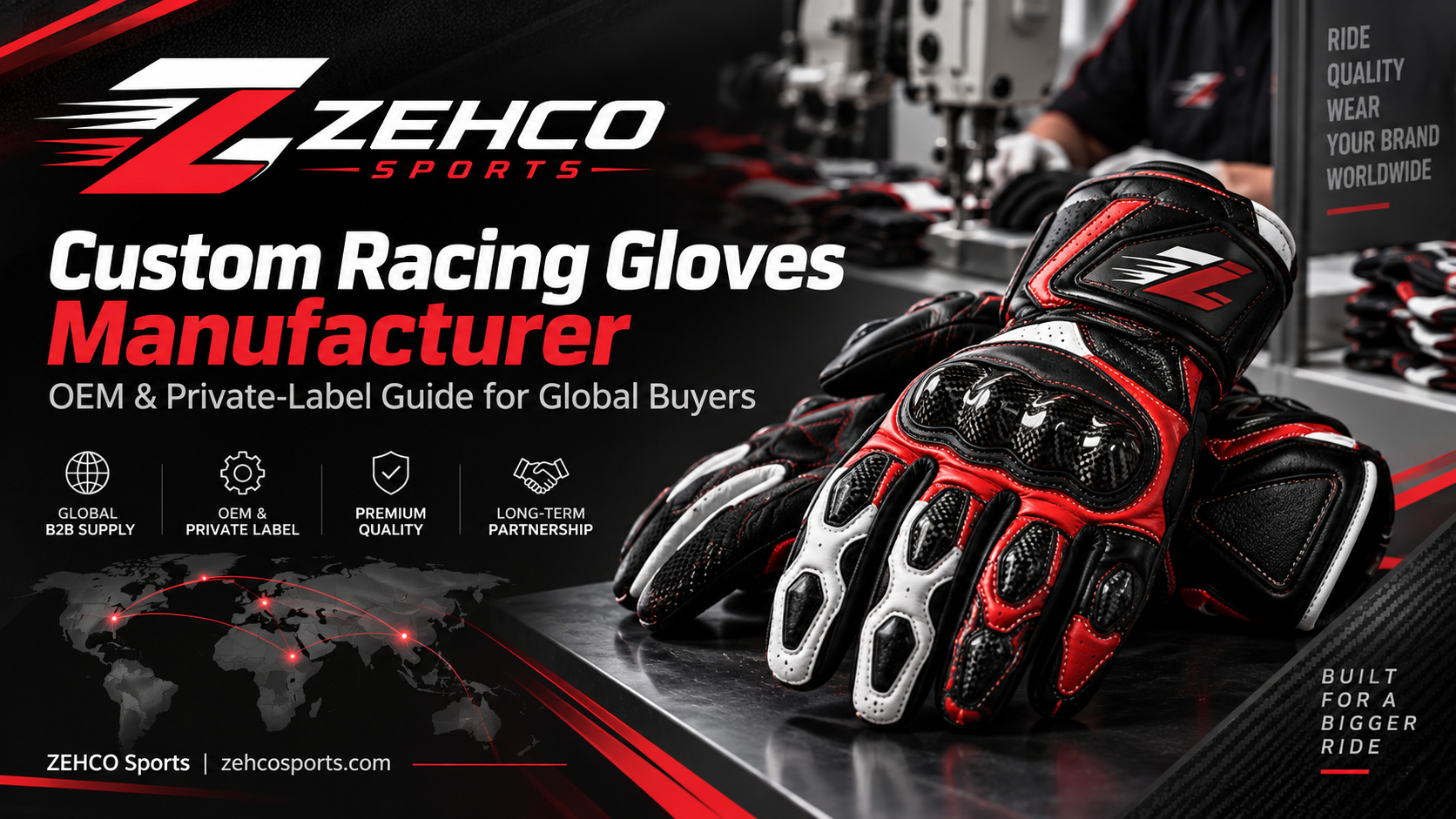
In addition to motorcycle jackets, buyers developing a broader riding collection can discuss related categories such as motorcycle racing suits, racing gloves and other customized motorsport apparel.
Conclusion: Selecting the Right Custom Motorcycle Jackets Manufacturer
A dependable custom motorcycle jackets manufacturer should offer more than basic garment production. International buyers need a partner capable of understanding technical specifications, selecting appropriate materials, developing accurate samples, maintaining sizing, applying private-label branding and controlling quality during repeat bulk production.
Before confirming an order, buyers should finalize the material specification, protection requirements, measurements, branding, sample approval process, MOQ and packaging instructions. This structured sourcing approach reduces production risk and creates a stronger foundation for long-term motorcycle apparel manufacturing.
ZEHCO Sports supports international brands, distributors and sourcing professionals looking to develop custom leather and Cordura motorcycle jackets in Sialkot, Pakistan. Buyers can submit their designs, technical packs, reference images or product specifications to begin discussing sampling and OEM or private-label production.