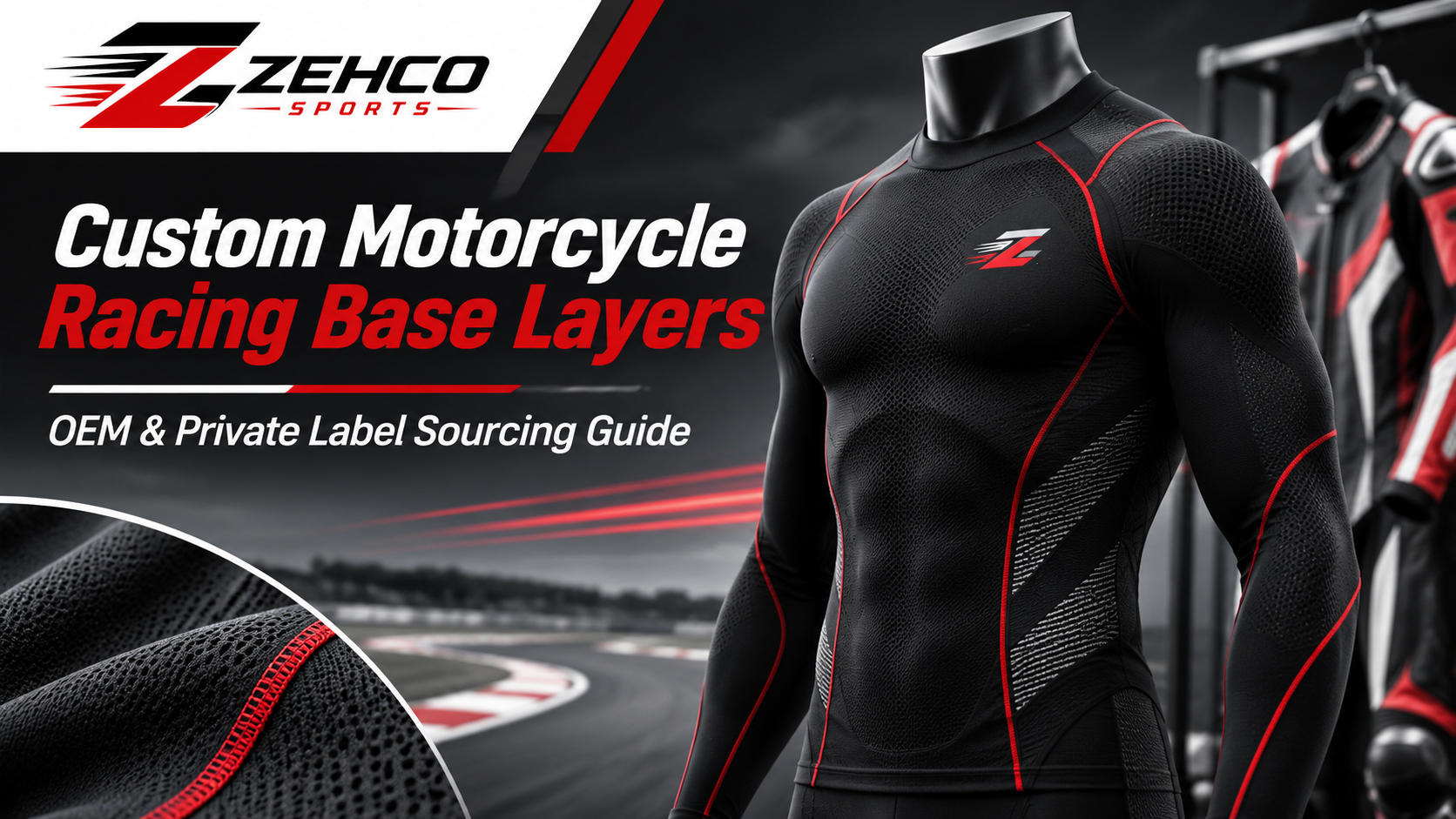
Custom motorcycle racing base layers are an important product category for brands developing coordinated riding apparel and accessories. Worn beneath suitable outer riding garments, these lightweight underlayers are intended to improve next-to-skin comfort, help manage perspiration and reduce unwanted fabric bunching during movement. For distributors, motorcycle clothing brands and racing teams, developing a successful base layer involves more than selecting a stretch fabric and adding a logo.
A commercial sourcing program must consider the intended riding environment, applicable competition rules, fabric behavior, garment construction, body measurements, sample approval and repeatable production quality. ZEHCO Sports, a Sialkot-based OEM/ODM sportswear and racing-gear manufacturer, provides a sourcing contact for buyers exploring private-label manufacturing projects. This guide explains the specifications buyers should establish before requesting a quotation for motorcycle undersuits.
Understanding Motorcycle Racing Base Layer Product Categories
A motorcycle base layer is a garment worn close to the body, generally beneath a motorcycle jacket, trousers or one-piece riding suit. Its primary function is to provide a comfortable textile interface between the skin and outer equipment. It should not be marketed as abrasion-resistant protective clothing, impact protection or certified racing underwear unless the exact product has undergone the relevant assessment and the claims are documented.
One-Piece Motorcycle Undersuits
A one-piece undersuit combines the upper and lower portions into a continuous garment. This design eliminates a separate waistband and can reduce overlapping fabric around the waist. Buyers should specify the neckline, front opening, sleeve length, leg length, torso stretch and whether a zipper or another closure is required. Closure placement deserves particular attention because pressure points may develop beneath a tightly fitted leather suit.
Two-Piece Base Layer Sets
Two-piece systems consist of a separate top and leggings. They offer more flexibility for size combinations, replacement purchasing and changing between riding sessions. However, the shirt hem must remain in position when the rider bends forward, while the leggings waistband should avoid unnecessary bulk. Brands can also develop separate upper and lower pieces for different climates or retail price categories.
Choosing Fabrics for Motorcycle Racing Underlayers
Fabric selection begins with the product's intended use. For ordinary non-regulated riding applications, buyers may evaluate technical knit fabrics containing polyester, polyamide or other fibers, sometimes blended with elastane for stretch. Relevant characteristics include moisture transport, drying behavior, fabric recovery, hand feel, breathability and dimensional stability after washing. These characteristics must be assessed through samples rather than inferred solely from a fabric composition label.
Open-knit or mesh panels may help airflow in selected body zones, although their effectiveness depends on the outer garment and actual riding conditions. A heavier brushed knit may suit a cooler-weather recreational product, whereas a lighter knit can be considered for warm-weather comfort. Buyers should specify whether the garment is intended for summer riding, cooler conditions or everyday use rather than assuming one material will perform equally well everywhere.
Competition Rules and Material Safety
Motorcycle racing base layers require particular care when sourcing for organized competition. Certain motorcycle racing regulations restrict undergarments made from synthetic materials that could melt and damage the rider's skin. Therefore, ordinary polyester-elastane sportswear must not automatically be represented as suitable for sanctioned racing. Buyers should identify the championship, governing body, applicable rulebook and current season before approving materials. Where a specific material, protective performance or certification is required, evidence must be obtained and reviewed before any compliance claim is made.
Ergonomic Pattern Development and Riding Position
Motorcycle riding places different demands on a garment than standing or casual walking. Riders regularly flex their elbows and knees, lean forward, rotate their shoulders and maintain a seated position for extended periods. Patterns should account for these movements by reviewing sleeve orientation, back length, crotch geometry, knee shaping and the distribution of fabric tension.
Measurements and Size Grading
A practical technical specification should provide chest, waist, hip, shoulder, sleeve, inseam and total torso measurements, together with a clearly defined measurement method. Buyers must distinguish body measurements from finished garment measurements. Stretch allowance, intended compression and garment recovery can influence the pattern. Size grading should be evaluated across the proposed range rather than relying exclusively on a medium-size sample.
Where a base layer is designed specifically for use beneath an existing leather racing suit, a fit trial with that outer suit is valuable. Test whether sleeves pull upward, seams cause pressure, fabric gathers behind the knees or the neckline creates discomfort. The approved design should allow the rider to move without excessive looseness or restrictive compression.
Seams, Panels and Construction Quality
Construction details have a direct effect on wearer comfort. Depending on the selected fabric and production feasibility, flatlock seams or other low-profile seam constructions may reduce the sensation of bulky seam allowances against the skin. Buyers should examine seam stretch, needle damage, thread quality, stitch consistency and whether panel joins remain comfortable under the pressure of outer garments.
Special attention is needed at the underarms, inner thighs, crotch, ankles and wrists. These areas experience repeated movement or friction with adjacent clothing. Reinforcement should not create rigid or bulky ridges. A garment that looks attractive on a display mannequin may behave differently when tested in a riding position, making practical fit evaluation essential.
Private-Label Branding and Custom Decoration
Private-label motorcycle base layers can incorporate brand colors, coordinated panel layouts, subtle printed artwork, woven size labels and branded retail packaging, subject to the chosen production method. Decoration should be selected according to the fabric surface, stretch requirements and intended use. For example, a rigid decorative transfer positioned across a highly elastic panel may interfere with stretch or deteriorate during use.
Buyers should provide vector artwork, approved colors, placement measurements and label instructions. Trial printing or decoration should be checked for wash behavior, stretch compatibility and legibility. Branding must never obscure required care information or suggest certification that the product does not possess.
Prototype Sampling and Approval Workflow
A structured sampling process can help prevent avoidable bulk-order disputes. The first prototype should verify fabric choice, garment dimensions, seam layout, comfort and basic construction. Any adjustments should be recorded in a revised specification rather than communicated only through informal messages. A second sample may be required when the original design changes substantially.
Before production approval, the buyer should confirm the final fabric reference, measured dimensions, approved colors, placement of branding, labeling and packaging. A signed sample or documented sample-approval record provides a clearer reference for subsequent inspection. If performance testing is necessary, the test method, laboratory and acceptance criteria should be agreed upon separately.
Quality Control for Bulk Motorcycle Undersuit Orders
Consistent quality is especially important when the finished garments will be sold under a retailer's or racing team's identity. An inspection plan should be established before manufacturing starts and should define acceptable tolerances, inspection methods and responsibility for resolving nonconformities.
- Fabric verification: Check the approved material reference, color, hand feel, stretch behavior and visible defects.
- Dimensional checks: Measure critical points against the approved size chart and documented tolerances.
- Seam inspection: Review stitch formation, seam elasticity, loose threads and skipped stitches.
- Branding checks: Confirm artwork position, color consistency, label accuracy and print appearance.
- Wear and care evaluation: Assess sample comfort, washing results and appearance retention using agreed procedures.
- Packing verification: Confirm size assortments, product identification, quantities and carton markings.
Visual inspection alone cannot establish safety certification or technical performance. Any regulated property should be supported by appropriate documentation relating to the actual product being supplied.
MOQ, Packaging and Production Lead-Time Factors
Minimum order quantities depend on fabric availability, the number of patterns, colors, decoration methods and size assortment. A stock fabric may allow a different production arrangement from a specially developed textile or an exclusive color. Buyers should request project-specific MOQ confirmation rather than assuming one minimum applies to all designs.
Packaging options may include individually folded garments, protective bags, branded inserts, size stickers and export cartons, depending on the agreed specification. Production lead time can be influenced by material procurement, prototype revisions, printing approvals, order volume, quality checks and shipping arrangements. Sample development, bulk manufacturing and international transit should be treated as separate scheduling stages.
What to Include in a Motorcycle Base Layer RFQ
A detailed request for quotation enables a manufacturer to evaluate the design accurately and highlight specifications that still require confirmation. International brands and purchasing managers should share the following information:
- Product format: One-piece undersuit, long-sleeve top, leggings or coordinated set.
- Intended use: Recreational riding, track-day use or a named sanctioned competition with applicable rules.
- Material: Required fiber composition, fabric weight if specified, stretch characteristics and approved references.
- Technical design: Size chart, measurements, seam construction, closure placement and panel layout.
- Branding: Logo files, colors, decoration method, labels and packaging artwork.
- Commercial details: Estimated order quantities, size distribution, destination market, sampling expectations and requested delivery terms.
- Verification: Any applicable safety, labeling, testing or regulatory documentation required for the target market.
It is also useful to state the intended sales channel and expected reorder pattern. These details help the parties discuss material continuity, possible size assortments and future production planning without assuming guaranteed stock or pricing.
Conclusion: Developing Reliable Custom Motorcycle Racing Base Layers
Sourcing custom motorcycle racing base layers successfully requires coordinated decisions about material suitability, pattern engineering, comfortable construction, branding, inspection and commercial terms. The most important distinction is between a comfort-focused technical underlayer and a product specifically approved for regulated competition. Claims concerning protective performance must be verified rather than assumed.
Brands, distributors and motorcycle apparel sourcing teams can contact ZEHCO Sports through https://zehcosports.com/ to discuss their technical requirements, proposed quantities, private-label artwork and sampling needs. A complete specification and an approved prototype create a more reliable foundation for evaluating OEM motorcycle undersuit production.