Finding the right custom Muay Thai shorts manufacturer involves more than choosing an attractive design. For combat sports brands, martial arts academies, professional teams and wholesale distributors, the garment must combine traditional Thai boxing aesthetics with reliable construction, practical movement and consistent sizing. Fabric selection, leg openings, waistband structure, branding methods and quality inspections all influence the finished product.
ZEHCO Sports, a Sialkot-based OEM/ODM sportswear manufacturer, works with international buyers developing customized sportswear and fightwear collections. This guide explains how buyers can prepare specifications, evaluate samples and communicate requirements for private-label Muay Thai shorts without relying on vague descriptions or unverified performance claims.
What Makes Muay Thai Shorts Different?
Traditional Muay Thai shorts are usually shorter and wider through the leg than conventional boxing trunks or many MMA training shorts. Their characteristic cut helps accommodate high kicks, knee strikes, footwork and clinch training. A broad elastic waistband provides support, while side openings increase room for hip and thigh movement.
These design characteristics are starting points rather than fixed universal specifications. A competition-oriented design may emphasize a traditional silhouette, while a gym merchandise collection may prioritize easy washing, comfortable daily wear or greater coverage.
Traditional and Contemporary Designs
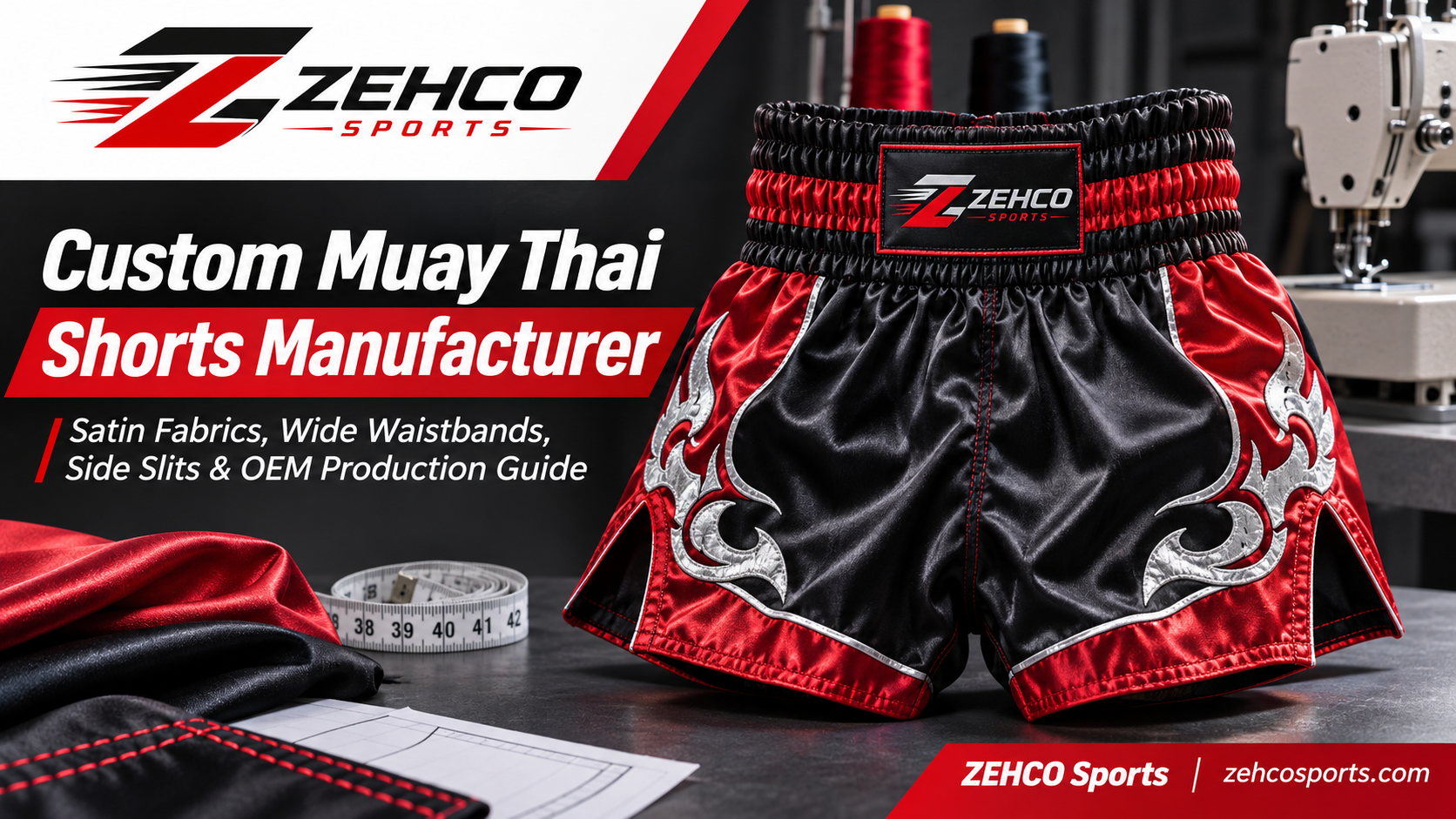
Traditional Thai-style shorts commonly feature glossy satin, a generous waistband, decorative lettering, contrast trims and curved side slits. Contemporary training styles may use matte polyester fabrics, simpler graphics, lighter embellishment or modified lengths. Buyers should identify their intended customer before selecting one pattern for an entire collection.
Choosing Fabrics for Custom Muay Thai Shorts
Polyester satin is a familiar option for traditional Muay Thai shorts because its smooth, lustrous surface creates the recognizable fightwear appearance. However, satin describes a fabric weave and appearance rather than a single universal fiber composition. Buyers should request the precise fiber content, fabric weight, finish and hand feel of every proposed material.
Woven polyester alternatives may suit training collections that need a less glossy surface or a different drape. Lightweight synthetic fabrics can also be considered when the design requires extensive printing. Their suitability depends on the selected textile, finishing process and physical sample.
Fabric Questions Buyers Should Ask
- What is the exact fiber composition and measured fabric weight?
- Is the finish glossy, semi-glossy or matte?
- How does the material behave after repeated washing?
- Does it show unwanted transparency under strong lighting?
- Can it support embroidery, appliqué or the proposed printing process?
- Will the same fabric quality and color be available for repeat orders?
Request representative swatches before making a fabric decision. Color accuracy, surface appearance and texture should be assessed on actual material rather than computer mockups alone.
Fit, Measurements and Size Grading
Muay Thai shorts require a size specification that accounts for both waist fit and leg mobility. A label such as medium or large is insufficient because sizing conventions differ across brands and markets. Buyers should provide measurements in centimeters or inches and clearly identify whether each measurement represents the garment laid flat or the intended body dimension.
Important measurements include relaxed waistband width, stretched waistband range, front rise, back rise, outseam length, leg opening width and side-slit depth. Buyers should also identify where measurements begin and end so the factory and purchasing team use the same method.
For youth ranges, adult collections and women-specific patterns, fit should be assessed separately instead of assuming that one grading rule will satisfy every user. Test samples should be worn during controlled kicking, squatting and footwork movements to identify pulling, waistband movement or excess fabric.
Waistband, Side-Slit and Seam Construction
The waistband is a central functional component. Its finished width, elastic quality, tension and attachment method affect how securely the shorts remain positioned. An internal drawcord can be considered if the product specification calls for additional adjustment. The waistband should be checked for twisting, uneven gathering and discomfort during movement.
Side slits must balance freedom of movement with acceptable coverage. Buyers should define the desired slit depth and shape instead of using the word high-cut without measurements. Stitch reinforcement at the top of the slit and other stress areas should be considered during pattern development.
Seam selection, edge finishing, lining choices and decorative piping should be reviewed together. Bulky seam allowances or poorly positioned trims can create friction, while inadequate finishing may affect garment durability. The approved sample should establish the construction reference for subsequent production.
Custom Branding, Embroidery and Printing
Private-label Muay Thai shorts can feature gym names, team colors, fighter identities and brand graphics. Common decoration methods include embroidery, fabric appliqué, heat-applied graphics and printing. Each method has different implications for appearance, production complexity and fabric compatibility.
Embroidery can provide a traditional raised finish but dense designs may stiffen lightweight fabric or cause puckering. Appliqué can create bold lettering or layered decorative effects, although its edges and attachment need careful inspection. Heat-applied graphics require compatibility checks for washing and fabric finishing. Sublimation should only be specified when the selected polyester-based fabric and production process are suitable.
Buyers should provide vector artwork where possible, state logo dimensions and positions, define color references and obtain a decoration sample. If Thai script or other non-Latin lettering is requested, spelling and layout must be checked by an appropriately qualified reviewer before approval.
From Tech Pack to Approved Production Sample
A useful technical pack includes front and back garment drawings, fabric details, measurement charts, seam and trim instructions, decoration artwork, packaging requirements and an itemized size breakdown. Even when a buyer begins with a reference photograph, a written specification is needed to prevent misunderstanding.
Sampling should confirm fit, actual fabric, color, embroidery or printing, waistband performance, side-slit finishing and overall workmanship. Buyers can document revisions using photographs and a numbered comment list. Bulk production should begin only after the parties agree on the approved reference sample and final specification.
MOQ, Cost Drivers and Production Lead Times
Minimum order quantity should be confirmed for each style, colorway and decoration configuration. An overall order quantity does not necessarily indicate how many pieces can be allocated across different sizes or graphics. ZEHCO Sports should confirm feasible order quantities against the buyer's actual specification instead of applying an assumed universal MOQ.
Cost is influenced by fabric selection, order volume, pattern complexity, embroidered area, trim details, labeling and packaging. Lead times can be affected by fabric procurement, artwork preparation, sampling revisions, production scheduling and inspection. Buyers should request separate confirmation of sample timing, bulk production timing and shipping transit rather than treating them as one guaranteed period.
Quality Control and Pre-Shipment Inspection
Quality control should compare finished shorts against the approved sample and purchase order. Measurements should be inspected using an agreed tolerance table, with attention to waist elasticity, leg symmetry, slit consistency, stitching, decoration placement and visible fabric defects.
Additional checks may include wash appearance, color consistency, seam strength, label accuracy and packaging counts. Any requested testing should be identified in advance with its method, responsible laboratory and acceptance criteria. No protective rating or certification should be assumed merely because the garment is intended for combat sports.
Packaging and International Order Preparation
Packaging can be specified for gym distribution, wholesale resale or private-label retail. Possible requirements include folded individual packaging, size stickers, woven brand labels, care labels, hang tags and carton markings. Buyers should confirm applicable labeling obligations in the destination market.
Before dispatch, request the final packing list, carton quantities, gross and net weights, shipment dimensions and agreed commercial documents. Shipping terms, freight responsibility and any import documentation should be confirmed in the sales agreement.
RFQ Checklist for Custom Muay Thai Shorts
A complete request for quotation helps a manufacturer assess production feasibility and prepare a useful commercial offer. Buyers should include:
- Target market, customer segment and intended training or competition use.
- Reference photos, tech pack or detailed pattern description.
- Fabric composition, finish, colorways and desired material characteristics.
- Full size chart, measurement method and order quantities by size.
- Waistband construction, drawcord preference and side-slit dimensions.
- Logo artwork, decoration methods, locations and dimensions.
- Private-label tags, care labels, folding and packaging requirements.
- Sampling expectations, inspection requirements and desired delivery window.
- Destination country, requested shipping terms and repeat-order plans.
Ask the supplier to identify any specifications that require clarification, alternative materials or prototype validation before quoting the final production price.
Conclusion: Building a Reliable Private-Label Muay Thai Shorts Collection
Choosing a custom Muay Thai shorts manufacturer should be a technical sourcing decision as well as a branding decision. Well-documented fabric choices, measured patterns, appropriate decoration, approved samples and practical quality checks help reduce avoidable problems during production.
Brands, clubs and distributors evaluating ZEHCO Sports can share their design references, size breakdown, artwork and target quantities through https://zehcosports.com/ to discuss suitable OEM/ODM manufacturing specifications and obtain a project-specific quotation.