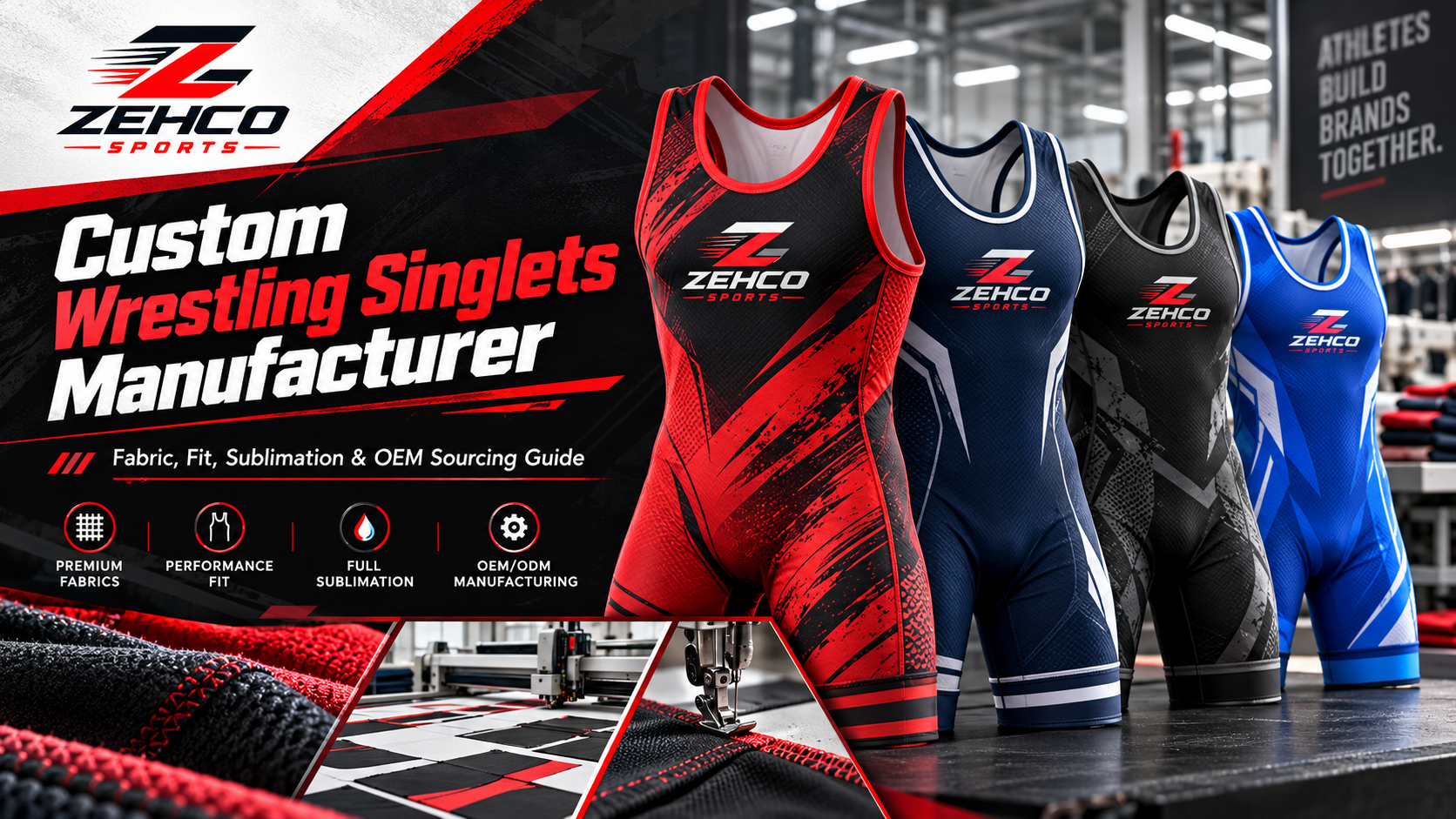
Choosing a reliable custom wrestling singlets manufacturer involves more than selecting attractive team colors or adding a club logo. Wrestling singlets are close-fitting performance garments designed for repeated stretching, rapid changes of body position and demanding contact during training and competition. Fabric recovery, construction quality, accurate sizing and competition-specific design requirements all influence the final product.
For sportswear brands, wrestling clubs, distributors and institutional buyers, understanding these manufacturing details makes it easier to prepare accurate specifications, compare supplier quotations and minimize problems before bulk production. This guide explains the key factors involved in sourcing custom wrestling singlets through OEM and private-label manufacturing arrangements.
1. Understanding Custom Wrestling Singlets and Their Applications
A wrestling singlet is a one-piece, sleeveless garment that generally covers the torso and extends over part of the upper legs. Its close-fitting construction helps reduce loose fabric that could interfere with movement or create unwanted gripping points during wrestling activity.
Custom wrestling singlets are commonly sourced for school wrestling programs, professional and amateur clubs, competitive teams, sporting organizations and private-label athletic apparel collections. Different applications may require different patterns, compression preferences and visual identities.
Competition Singlets Versus Training Singlets
Competition singlets must be developed around the applicable federation or event requirements, including approved cuts, uniform colors, identification and logo placement. Training singlets may offer greater design flexibility, although wearer comfort and durability remain essential. Buyers should identify the intended competition governing body before approving production artwork.
2. Selecting the Right Performance Fabric
Fabric selection influences flexibility, breathability, durability, opacity and the way the singlet feels against the skin. Common development options include polyester-elastane and nylon-elastane knitted fabrics. The ideal composition depends on the target market, desired compression, decoration method and testing results.
Polyester-Elastane Fabric
Polyester-elastane blends can provide multidirectional stretch, shape recovery and compatibility with certain dye-sublimation production methods. Polyester-based fabrics are particularly relevant when teams require intricate graphics, gradients, mascots or extensive custom coloring. The manufacturer should confirm the exact fabric construction and printing compatibility before sampling.
Nylon-Elastane Fabric
Nylon-elastane fabrics are another option for smooth, close-fitting wrestling apparel. Depending on yarn, knit and finishing, they may offer a different hand feel or surface appearance from polyester blends. However, a suitable printing and color-development process must be established because methods intended for polyester are not automatically interchangeable with nylon.
Buyers should request fabric swatches and evaluate thickness, opacity under stretch, recovery after extension, surface feel, color consistency and performance after repeated laundering. Fabric weight in GSM is useful for comparing options but should never replace physical testing and sample evaluation.
3. Ergonomic Pattern Development and Athlete Measurements
The quality of a wrestling singlet depends heavily on pattern development. A garment that fits properly while standing may become uncomfortable during squatting, bending, sprawling or grappling movements. An effective pattern must accommodate these positions without excessive pulling, slipping or restrictive pressure.
Important Measurements
- Chest circumference: Helps establish upper-body coverage and stretch allowance.
- Waist and hip circumference: Supports appropriate compression through the middle and lower body.
- Torso girth: Measures the body through the shoulder and crotch area to help determine vertical fit.
- Inseam and leg opening: Influences coverage, mobility and whether the garment rides upward.
- Shoulder width and armhole depth: Affect upper-body comfort and wrestling movement.
Men's, women's and youth patterns should be evaluated separately where appropriate rather than simply reducing or enlarging one universal pattern. Buyers should supply their target size range, measurement definitions and acceptable finished-garment tolerances.
4. Stitching, Seams and Construction Quality
Seam construction is especially important because wrestling apparel experiences repeated tension across the shoulders, torso, crotch and upper legs. Suitable stretch-seam construction, including flatlock or other carefully selected methods, should be assessed according to the chosen material, equipment and garment design.
Flatlock stitching may help create a relatively smooth seam profile, while other stretch-compatible seams can also be appropriate when correctly developed. Buyers should inspect seam extension, recovery, thread ends, stitch consistency and resistance to opening under movement.
Neckline and armhole finishing also deserve attention. Rough edges, stiff labels, heavy decoration or poorly positioned seam allowances can create discomfort. Crotch construction and leg openings should be examined during actual athletic movements, rather than only on a mannequin.
5. Sublimation Printing, Team Branding and Private Labels
Custom artwork is a major purchasing consideration for wrestling clubs and athletic brands. Dye-sublimation on compatible polyester fabric can integrate multicolor designs into the textile rather than applying a thick surface layer. It is particularly useful for all-over graphics and coordinated team collections.
Artwork should be supplied in suitable high-resolution or vector formats, with clearly identified colors, logo dimensions, placement coordinates and approved front-and-back layouts. Buyers should review how graphics align across seams, panels and curved body areas.
Branding and Label Options
Depending on the agreed product specification, branding details may include printed neck identification, woven labels, size labels, care instructions and branded individual packaging. Heavy embroidery or bulky patches on highly elastic zones should be assessed carefully because they may alter stretch, comfort or surface smoothness.
Artwork approval must include a competition-rules review. United World Wrestling issued uniform clarifications in January 2026 addressing color restrictions, red and blue markings, athlete identification, sponsor-logo placement and undergarment visibility. Requirements differ between competitions and jurisdictions, so the relevant rules must be checked before finalizing the design.
6. Sampling and Pre-Production Approval
Sampling is the most effective opportunity to identify pattern, material and decoration problems before committing to quantity production. Buyers should agree on a development process that covers initial technical specifications, prototype construction, athlete fit evaluation and final approval.
A practical sample assessment should include visual inspection, stretching movements, fit photographs, washing trials and comparison against the approved measurement chart. Evaluate whether the singlet becomes excessively transparent when stretched, whether the neckline remains comfortable and whether leg openings stay in the intended position.
Any requested changes should be documented in a revised specification. A final approved sample should become the reference for bulk manufacturing, including fabric, construction, artwork and packaging.
7. MOQ, Production Planning and Lead-Time Factors
Minimum order quantity, or MOQ, depends on the agreed manufacturing arrangement, fabric availability, color assortment, decoration process and size distribution. Buyers should request written clarification of the minimum quantity per design, per color and per size rather than assuming these limits are identical.
Production planning should account for fabric sourcing, artwork confirmation, sampling revisions, cutting, printing, sewing, inspections and packing. Requiring a new custom material or multiple artwork versions may create additional preparation stages. Buyers should also confirm whether the quoted manufacturing timeline begins after sample approval, deposit receipt or material availability.
For seasonal team programs, it is sensible to build time for athlete roster changes, replacement sizes, possible rework and shipping arrangements into the procurement schedule.
8. Quality Control and Bulk Order Inspection
Quality control should start with approved materials and clear technical specifications. Incoming fabric can be examined for shade variation, defects, dimensional behavior and stretch consistency. During production, cutting and sewing checkpoints help identify incorrect panel alignment or seam construction.
Finished-garment inspection should evaluate measurements, artwork placement, stitching, labeling, visible fabric defects and overall appearance. Buyers may also agree on wash testing, seam-strength evaluation and stretch-recovery checks suited to the selected textile and intended use.
- Compare finished measurements against the approved specification and tolerances.
- Check logo positioning, spelling, color matching and print registration.
- Review seam quality and stretching behavior in high-tension areas.
- Inspect garment symmetry, neckline, leg openings and coverage.
- Verify individual labeling, size sorting and agreed packing requirements.
Inspection methods, sample sizes and acceptance criteria should be agreed before production. A visually acceptable singlet is not automatically suitable for a particular sporting federation or certified performance claim.
9. Packaging and International Shipping Preparation
Appropriate packaging helps maintain presentation and order accuracy during handling and international transportation. Singlets can be folded individually with size identification and buyer-approved product information, then grouped into cartons using a clearly documented packing list.
Buyers should specify whether packaging requires individual bags, barcode labels, carton marks, size assortments or retail-ready presentation. Commercial invoices, packing lists, product descriptions and any destination-specific textile labeling or import documentation should be reviewed according to the importing market.
Freight terms such as FOB, CIF or other agreed Incoterms must be confirmed in the sales contract. The buyer and supplier should also establish responsibility for freight, insurance, customs clearance and applicable import charges.
10. How to Prepare an Accurate OEM Wrestling Singlet RFQ
A complete request for quotation helps manufacturers respond with a comparable and commercially meaningful proposal. Instead of requesting only a price for a custom singlet, buyers should provide the following information:
- Product type, intended wrestling discipline and destination market.
- Applicable competition or federation uniform requirements.
- Target fabric composition, weight or approved reference sample.
- Men's, women's or youth patterns and required size breakdown.
- Total order quantity and distribution by artwork, color and size.
- Logo files, sublimation artwork, placements and labeling requirements.
- Sample requirements, inspection expectations and packing instructions.
- Required delivery window, destination and proposed shipping terms.
Buyers should ask suppliers to identify any specifications needing confirmation and to distinguish sample development, bulk production, packaging and freight arrangements in the quotation.
Conclusion: Choosing a Custom Wrestling Singlets Manufacturer
A successful wrestling apparel program starts with fabric selection, ergonomic pattern development, reliable stitching, accurate branding and structured quality control. Competition compliance, sampling approval and transparent OEM quotations are equally important for brands supplying athletes across different markets.
ZEHCO Sports is a Sialkot-based OEM/ODM and private-label sportswear manufacturing business serving international sourcing requirements. Buyers evaluating a custom wrestling singlets manufacturer can contact ZEHCO Sports through https://zehcosports.com/ to discuss design specifications, material options, sampling requirements and the feasibility of a proposed order. Product capabilities, quantities and schedules should be confirmed against the individual project brief.