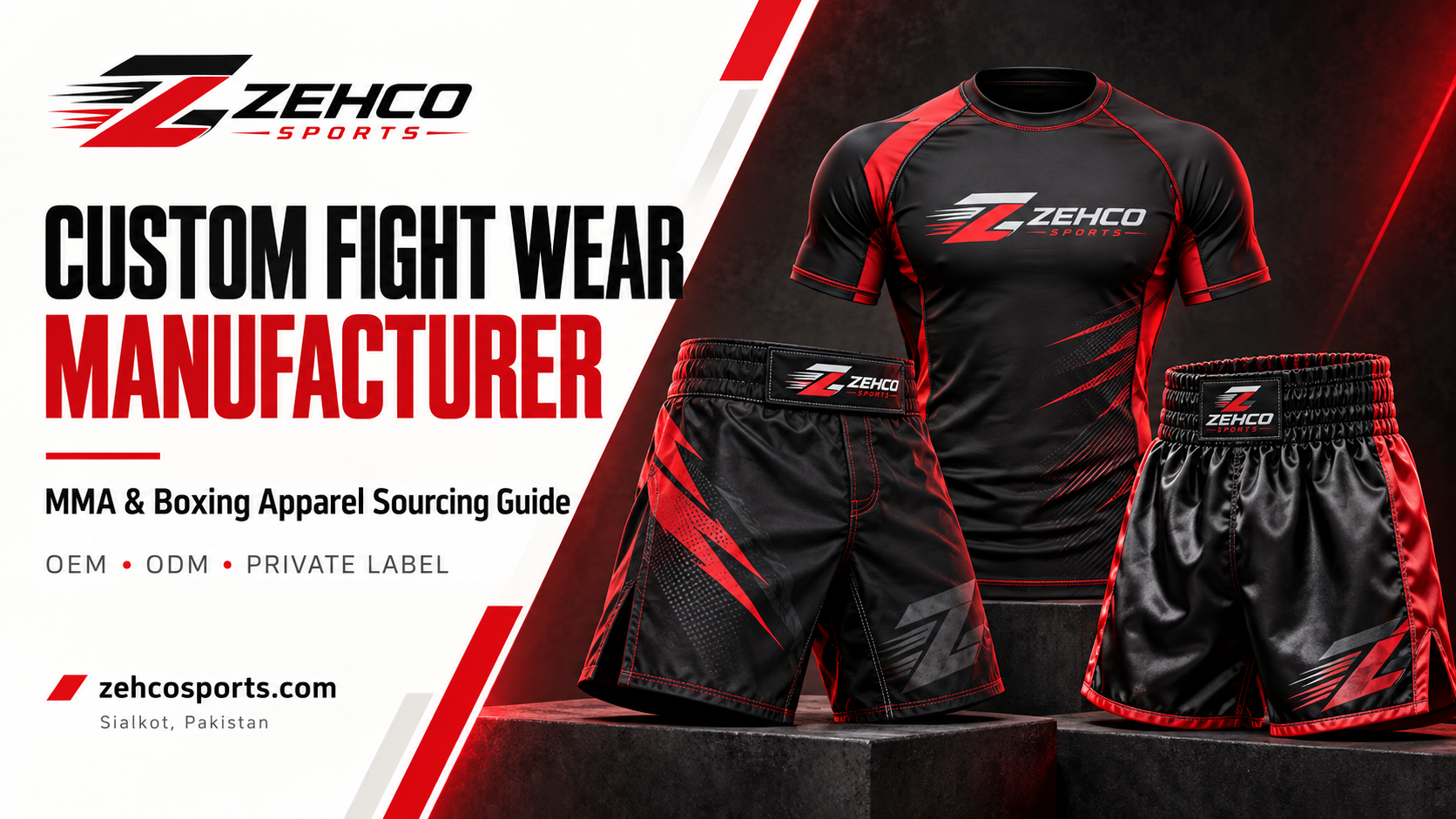
For Brazilian Jiu-Jitsu academies, mixed martial arts teams, grappling brands and combat sports distributors, a well-designed rash guard is more than a printed compression shirt. It must remain comfortable during ground movement, maintain its shape after repeated stretching and washing, and present team branding consistently across different sizes. Choosing the right custom MMA rash guard manufacturer therefore requires attention to fabric composition, garment engineering, measurement accuracy, decoration methods and production quality control.
ZEHCO Sports is a Sialkot-based OEM/ODM sportswear and fightwear manufacturer serving buyers interested in custom and private-label apparel. This guide explains the technical information buyers should prepare before requesting samples or quotations, how to evaluate garment construction and which production decisions influence quality, pricing and delivery schedules.
1. Why Custom MMA Rash Guards Need Specialized Specifications
MMA and BJJ rash guards experience repeated stretching, torso rotation, body contact and friction during training. Unlike ordinary casual T-shirts, they are generally designed to sit close to the body without unnecessarily restricting shoulder movement, breathing or grappling positions.
Buyers should define whether the intended product is for no-gi BJJ, MMA training, wrestling, fitness conditioning or general compression sportswear. These applications can share materials, but their preferred fit, sleeve length, design layout and garment details may differ. A training rash guard is not automatically certified protective equipment, and its suitability for a particular competition must be checked against the organizer's current rules.
2. Performance Fabrics for MMA and BJJ Rash Guards
Polyester and Elastane Blends
Polyester blended with elastane, also known as spandex, is a common material option for fitted sportswear. Polyester provides a versatile foundation for lightweight technical fabrics and is particularly compatible with suitable dye-sublimation processes. Elastane contributes the stretch needed for close-fitting garments and dynamic movements.
The appropriate blend depends on the required stretch, fabric weight, opacity, hand feel and recovery. Buyers should not select a composition based only on its advertised percentage. Request physical swatches and compare how each fabric behaves when stretched in different directions.
Nylon and Elastane Blends
Nylon-based stretch fabrics are another option worth discussing when a brand prefers a particular softness, surface finish or wearing sensation. However, nylon and polyester behave differently during coloring and printing. The decoration process must be confirmed against the exact fabric selected rather than assumed to work identically on both materials.
Fabric Weight, Stretch and Recovery
Fabric weight is normally expressed in grams per square meter, or GSM. A higher GSM does not automatically mean better performance. Heavier material may change the garment's feel, drying behavior and fit, while a lighter material must still provide adequate opacity and recovery.
- Check stretch in both the lengthwise and widthwise directions.
- Assess recovery after repeated extension rather than judging initial elasticity alone.
- Inspect opacity when the fabric is stretched over the shoulders and torso.
- Compare comfort, breathability and drying behavior under intended training conditions.
- Confirm washing stability and surface appearance through approved sample testing.
3. Compression Fit, Sizing and Grappling Mobility
A successful rash guard should follow the body's contours without creating excessive tension at the neck, shoulders or underarms. Brands should establish whether they want a firm compression fit, a moderately fitted athletic profile or a more relaxed training version.
Measurements to Include in the Technical Pack
- Chest and waist garment measurements, with the measurement method clearly defined.
- Front and back body length from agreed reference points.
- Sleeve length, upper-arm circumference and cuff opening.
- Shoulder width, neckline dimensions and neck opening.
- Hem width and the intended degree of negative ease.
- Size grading rules and acceptable measurement tolerances.
Negative ease means the finished garment is smaller than the corresponding body measurement so the stretch fabric sits close to the wearer. The appropriate amount depends on fabric elasticity, pattern construction and the preferred wearing pressure. It should be approved through physical fitting rather than copied blindly from another product.
Fit samples should be checked during overhead arm movement, torso rotation, grappling frames and low athletic positions. Inspect whether sleeves ride excessively upward, the hem rolls toward the chest or the underarm seams create discomfort. Where teams require women's, youth or other distinct fits, separate pattern and grading requirements should be specified.
4. Seam Construction and Garment Durability
Seam selection can significantly affect comfort and durability. Flatlock-style seams are commonly considered for fitted activewear because they can reduce bulky seam allowances. Overlock and coverstitch combinations may also be suitable depending on the construction, stitch elasticity and seam placement.
Buyers should request samples showing the intended seam type rather than specifying a fashionable term without checking its actual execution. Stitch density, thread compatibility and seam extension must be assessed against the selected fabric.
Construction Details Worth Reviewing
- Shoulder and underarm seam positioning in relation to repeated movement.
- Side-panel construction and the placement of highly stretched areas.
- Neckband finish and comfort against the skin.
- Hem construction and resistance to unwanted rolling.
- Sleeve-end finishing and stretch recovery after use.
- Loose threads, skipped stitches, seam puckering and visible inconsistencies.
Special design features, such as longer back panels or additional pattern sections, should be requested and assessed individually. Their inclusion must be agreed during development rather than assumed as part of a standard production specification.
5. Sublimation Printing and Private-Label Branding
Full-color sublimation is a popular design route for compatible polyester-based rash guards. It can integrate artwork into suitable textile surfaces without creating the same raised print feel associated with some surface-applied decorations. Nevertheless, the final appearance depends on the material, printing process and artwork preparation.
Brands should submit vector logos when available, high-resolution graphics, accurate placement diagrams and a complete color brief. For complex artwork, the printing layout must account for individual pattern panels, seams, stretch distortion and the different proportions of each size.
Branding Elements to Specify
- Front, back, sleeve and collar artwork placement.
- Academy logos, sponsor marks and manufacturer or private-label identifiers.
- Color references and physical printed-swatch approval where needed.
- Size labels, care labels and country-of-origin labeling requirements.
- Optional packaging artwork and barcode placement.
Embroidery and certain heat-applied decorations may be unsuitable for heavily stretched zones because they can affect flexibility or comfort. Any alternative decoration must be evaluated on the exact garment fabric. Brands planning competition-specific colorways or markings should verify the relevant event regulations before final artwork approval.
6. Sampling Before Bulk Manufacturing
Sampling is an essential risk-control stage for custom MMA rash guard production. A digital mockup can communicate the design concept, but it cannot demonstrate actual compression pressure, seam comfort, fabric recovery or washing performance.
An effective approval process may include a fabric-selection stage, a fit or construction sample, an artwork sample and a final pre-production reference. The number of iterations depends on the complexity of the design and how complete the initial technical pack is.
Sample Approval Checklist
- Confirm the fabric composition, approved hand feel and weight.
- Measure the garment against the agreed specification sheet.
- Check fit during realistic training movements.
- Review printed color, artwork alignment and logo placement.
- Inspect seams under appropriate stretching and handling.
- Evaluate washing results, color appearance and shape retention.
- Record required corrections and approve the final reference sample.
Bulk production should follow the approved specifications and reference sample, with any material or construction changes communicated before implementation.
7. MOQ, Manufacturing Lead Times and Order Planning
Minimum order quantity, commonly called MOQ, is influenced by fabric availability, printing requirements, pattern variations, color combinations and overall production setup. There is no reliable universal MOQ for every private-label rash guard project.
Buyers should explain their intended quantity per design, color and size rather than providing only a total order volume. A single design across several sizes can require different production planning from multiple small designs with separate artwork.
Lead-time planning should distinguish sample development, artwork approval, material sourcing, production, final inspection and transportation. Changes to approved artwork, fabric or size specifications can affect these stages. Request a written production schedule and clarify whether the quoted delivery date refers to factory completion, dispatch or arrival at the destination.
8. Quality Control for Custom Grappling Apparel
Quality control should start before sewing begins. Incoming fabric should be checked against the approved material specification, while cutting and printing require attention to panel consistency, artwork positioning and size identification.
During sewing, inspection should focus on seam alignment, stitch consistency, neck and sleeve finishing, and visible workmanship. Final inspection should compare finished garments against the approved size chart, artwork reference, packaging requirements and agreed defect criteria.
Buyers can request a defined inspection arrangement, such as measurements taken from selected units and visual checks based on an agreed sampling plan. Any acceptance criteria, tolerances or independent testing must be specified contractually rather than presumed to apply automatically.
9. Packaging and International Shipment Preparation
Private-label packaging contributes to presentation, stock handling and distributor efficiency. Possible requirements include individual protective bags, size stickers, SKU labels, care information and carton identification. Each element should be confirmed in the purchase specification.
Ask the manufacturer to quote the estimated packing configuration, carton dimensions, net and gross weight, and dispatch arrangements once the final order details are known. These figures support freight planning but should not be estimated from unrelated products.
International buyers should also clarify the agreed Incoterms rule and named place, responsibility for shipping documentation, and any destination-specific textile labeling or import requirements. Applicable obligations vary by market and must be verified for the actual destination.
10. RFQ Checklist for Custom MMA Rash Guard Manufacturing
A detailed request for quotation helps manufacturers compare specifications accurately and reduces repeated clarification during development.
- Product category: short-sleeve or long-sleeve MMA/BJJ rash guard.
- Intended use: training, team uniform, retail collection or competition.
- Fabric preference: composition, GSM, stretch, opacity and finish.
- Fit profile: compression level, target size range and measurement chart.
- Construction: preferred seams, neckline, sleeve and hem finishes.
- Artwork: editable files, design variations and logo placements.
- Branding: woven or printed labels, care labels and packaging.
- Quantity: units by size, color and individual design.
- Sampling: required sample types and approval process.
- Quality expectations: inspection criteria and any requested testing.
- Commercial terms: quotation currency, shipping terms and destination.
- Schedule: target approval date, production deadline and dispatch requirements.
11. Working With ZEHCO Sports on OEM Rash Guard Development
ZEHCO Sports works in OEM/ODM sportswear and fightwear manufacturing in Sialkot, Pakistan. Brands seeking custom grappling apparel can begin discussions by submitting their garment concept, size requirements, preferred fabrics, design files and projected order quantities. Material options, sample development, decoration methods and commercial conditions should be confirmed against the specific project requirements.
For a growing BJJ academy or a private-label fightwear brand, the objective is not simply to obtain the lowest unit quotation. It is to create a repeatable product specification that supports consistent fit, approved branding and dependable bulk-order evaluation.
Conclusion: Choosing the Right Custom MMA Rash Guard Manufacturer
The right custom MMA rash guard manufacturer should be assessed through fabric suitability, movement-based fitting, seam quality, branding accuracy, transparent sampling and documented production expectations. Buyers who approve materials and construction before committing to bulk manufacturing are better positioned to avoid preventable sourcing problems.
To discuss an OEM or private-label MMA rash guard project with ZEHCO Sports, visit https://zehcosports.com/ and prepare a technical brief covering design, measurements, quantities, quality expectations and shipping requirements. A detailed RFQ provides a stronger foundation for practical manufacturing discussions and long-term product consistency.